Recall(Hallmarks #5–6)
Inducing angiogenesis (#5) and activating invasion and metastasis (#6). The transition from a microscopic clone to a macroscopic disease. Both from the original 2000 paper. Where the first four hallmarks were about the cell becoming self-sufficient, these two are about the tumor outgrowing its original constraints — acquiring a blood supply, then breaking out of the tissue of origin entirely.
The first four hallmarks are about the cell itself — its signaling, its survival, its division limit. Hallmarks #5 and #6 are about the cell's relationship to its environment. A tumor that has achieved cell autonomy is still constrained by physics: diffusion limits oxygen and nutrient delivery to roughly 1–2 mm from the nearest capillary. Without a blood supply, a tumor can't grow beyond that size. Without the ability to invade surrounding tissue, it remains local and — usually — manageable.
Angiogenesis solves the supply problem. Invasion and metastasis solve the containment problem.
The angiogenic switch
Normal vascular growth is tightly regulated. In adults, new blood vessel formation is largely suppressed — quiescent endothelial cells sit in a balance between pro-angiogenic signals (VEGF, FGF, angiopoietins) and anti-angiogenic signals (thrombospondin-1, angiostatin, endostatin). The tumor tips this balance decisively toward growth.
The angiogenic switch — the point at which a growing tumor mass flips from avascular to vascularized — is primarily driven by hypoxia. As the tumor outgrows its oxygen supply, HIF-1α accumulates and drives transcription of VEGF-A, the dominant pro-angiogenic signal. VEGF-A binds VEGFR2 on endothelial cells, driving their proliferation, migration, and tube formation toward the oxygen-depleted tumor.
The switch is also driven by oncogenic signaling independent of hypoxia: RAS activation, MYC overexpression, and loss of p53 all upregulate VEGF transcription even in normal oxygen conditions. This matters clinically — anti-VEGF therapy (bevacizumab) can be effective even in well-oxygenated tumors because the angiogenic signal isn't purely hypoxia-driven.
Intuition(Why tumor vessels are structurally chaotic)
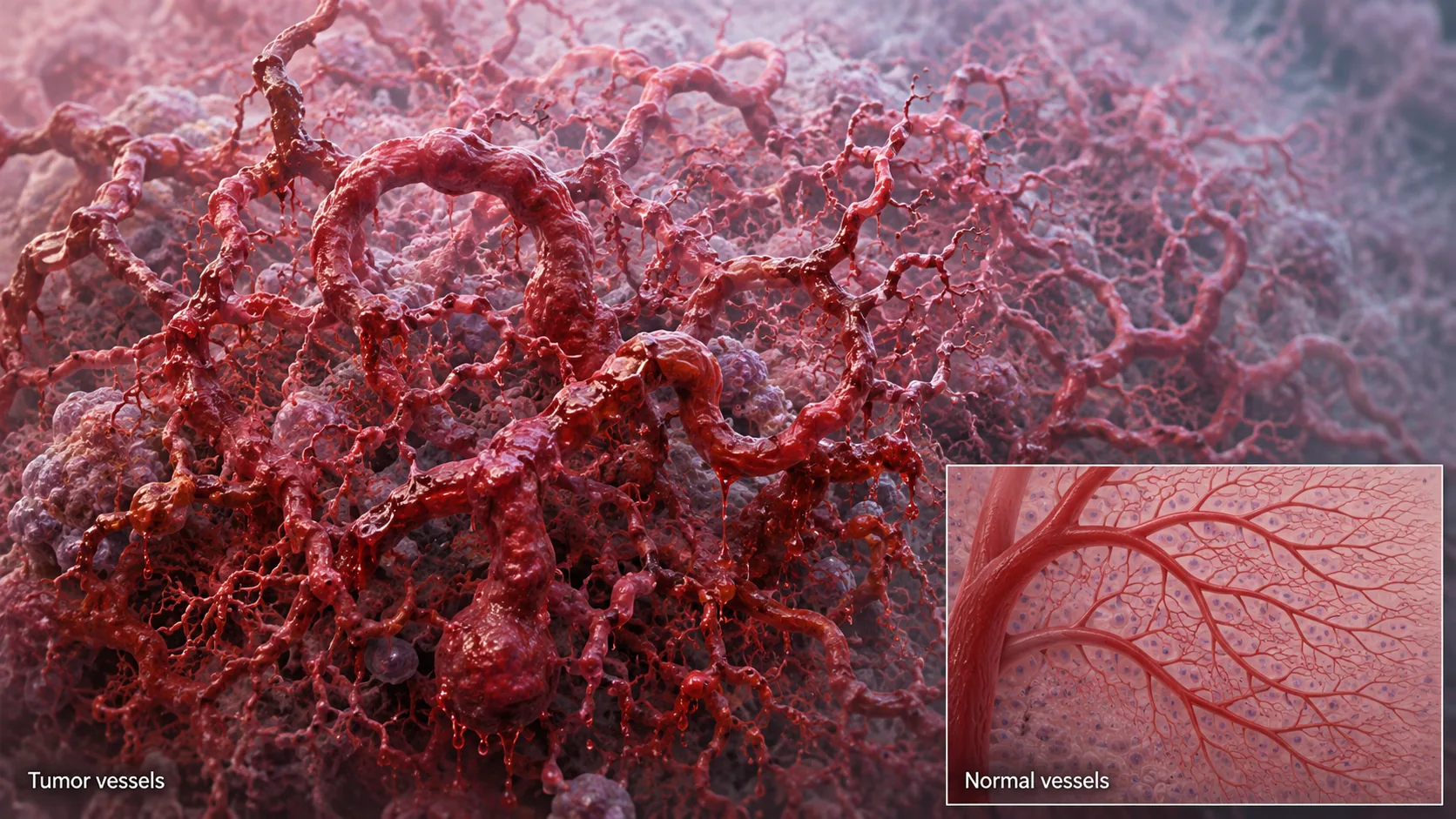
Normal angiogenesis — wound healing, development — produces vessels with orderly hierarchy: arteries branch into arterioles into capillaries. Tumor-induced angiogenesis is driven by an overwhelming, unregulated VEGF signal that recruits endothelial cells faster than they can form proper structures. The result is vessels that are tortuous, leaky, unevenly distributed, and intermittently perfused. Paradoxically this impairs drug delivery, creates hypoxic pockets that promote aggressive phenotypes, and increases interstitial fluid pressure — making the tumor simultaneously better fed and harder to treat than normal tissue.
The metastatic cascade
Metastasis — responsible for ~90% of cancer deaths — is often framed as cancer "spreading." The mechanism is more structured than that: a multi-step cascade where each step has its own molecular requirements and where the vast majority of attempts fail.
Local invasion requires degrading the basement membrane (through MMP secretion), losing E-cadherin-mediated epithelial adhesion, and acquiring the motility of mesenchymal cells through EMT. The EMT transcription factors (SNAIL, TWIST, ZEB1/2) are induced by exactly the microenvironmental signals the growing tumor generates: TGF-β from the stroma, hypoxia from inadequate perfusion, inflammatory cytokines from recruited immune cells. The growing tumor is generating its own invasion signals through the microenvironmental conditions it creates.
Intravasation, survival in circulation, and extravasation each impose additional selection. Circulating tumor cells cluster with platelets to survive shear stress and evade NK cells. Most die in transit. Those that extravasate at distant sites are in a foreign microenvironment and largely die or enter dormancy — sometimes for years before re-emerging.
Organotropism — the non-random pattern of where cancers metastasize — is driven by chemokine receptor-ligand compatibility (CXCR4 on breast cancer cells, CXCL12 concentrated in bone marrow and lung), exosome pre-conditioning of target organs, and metabolic compatibility with the destination tissue.
How they connect
These two hallmarks are usually taught separately, but they are mechanistically entangled.
Angiogenesis enables metastasis. Tumor vasculature is the physical route of intravasation — the leaky, fenestrated tumor vessels that form in response to VEGF are structurally easier for tumor cells to enter than normal, tight-junctioned capillaries. High intratumoral vessel density correlates with metastatic risk in several tumor types.
Macrophages bridge both. Tumor-associated macrophages (TAMs) promote angiogenesis by secreting VEGF and MMP9 (which releases matrix-bound VEGF stores), and they facilitate intravasation by creating paracrine co-migration programs with tumor cells. The same cell type drives both hallmarks simultaneously.
The anti-angiogenic therapy paradox. Bevacizumab and other VEGF-pathway inhibitors reduce primary tumor vascularity — but clinical data in some settings show increased invasiveness and distant metastasis after anti-angiogenic therapy. The mechanism: VEGF blockade drives tumor hypoxia, which activates HIF-1α-driven EMT programs. The tumor responds to having its blood supply cut by becoming more invasive. This doesn't negate anti-angiogenic utility, but it explains why combining anti-VEGF with anti-invasion strategies has biological rationale — and why neither hallmark can be cleanly separated from the other.
Summary(Summary)
Hallmarks #5 and #6 are the scale-up: angiogenesis converts a diffusion-limited microscopic clone into a vascularized mass; invasion and metastasis convert a local disease into a systemic one. HIF-1α links them — it drives VEGF-mediated vessel formation under hypoxia and EMT-mediated invasion when oxygen stays scarce. Tumor-associated macrophages participate in both. Anti-angiogenic therapy can, paradoxically, promote invasion by deepening hypoxia and activating EMT transcription factors — which is why these hallmarks need to be addressed together rather than sequentially. The ~90% of cancer deaths caused by metastasis are the clinical consequence of hallmark #6 succeeding at the end of the cascade that hallmark #5 enabled.