Recall(Hallmarks #9–10: a different category)
Genome instability and mutation (#9) and tumor-promoting inflammation (#10) are classified as enabling characteristics in the Hallmarks framework — a separate tier from the functional capabilities. They don't directly make the tumor grow, survive, or spread. They make it faster and easier for the tumor to acquire everything else. Think of them as the conditions that accelerate the system rather than outputs of it.
The distinction matters. The ten functional hallmarks describe what a cancer cell does. The two enabling characteristics describe the conditions under which a pre-cancerous cell is most likely to become — and to evolve into — a fully malignant one. Remove genome instability and tumor development slows dramatically. Remove the pro-tumorigenic inflammatory environment and many early lesions never progress. These aren't features of the established tumor so much as features of the environment in which the tumor develops.
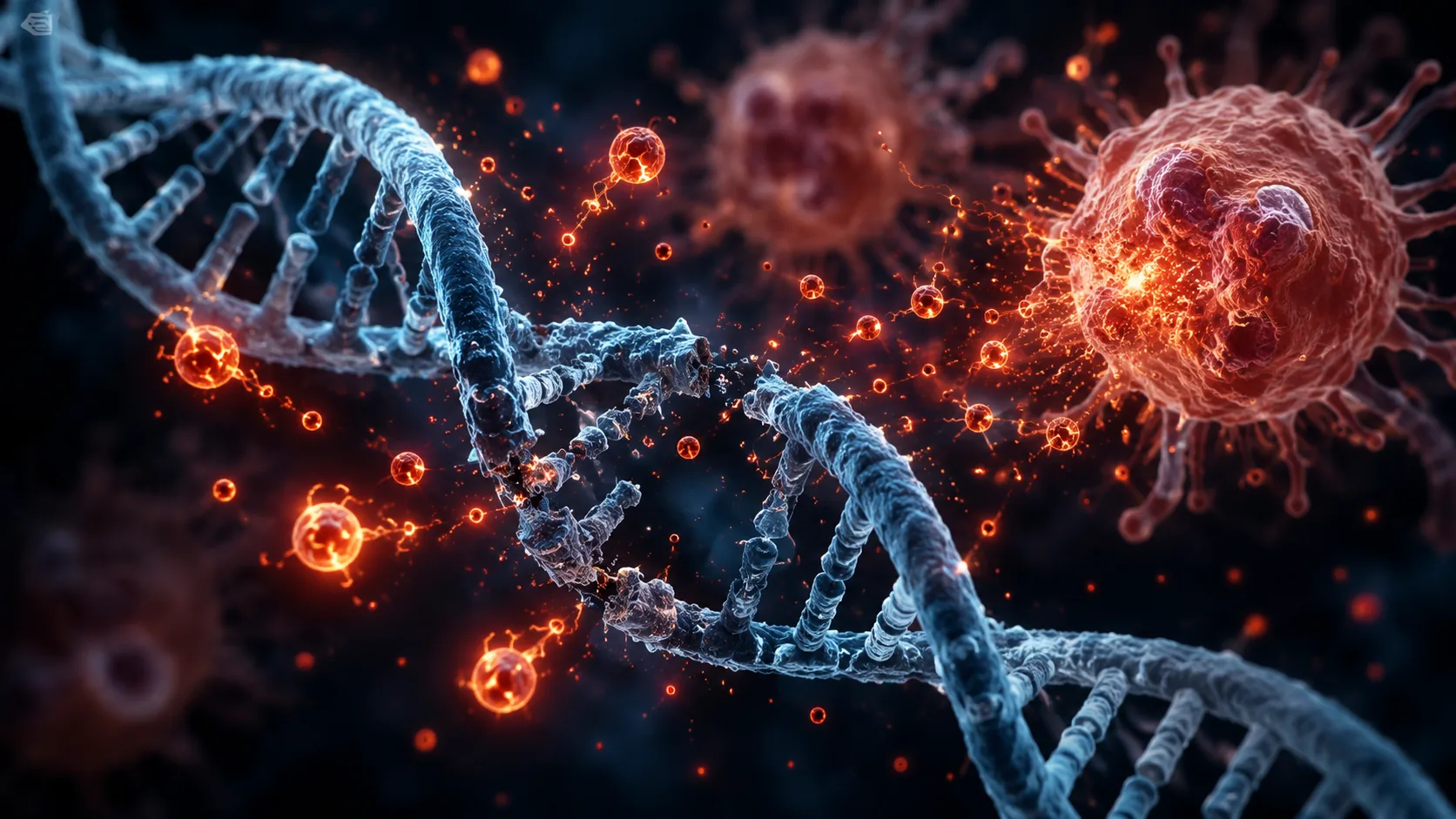
Why an unstable genome accelerates everything
A normal cell accumulates 1–2 mutations per division — low enough that acquiring the several driver mutations needed for malignancy over a lifetime is statistically possible but uncommon. Cancer cell lineages accumulate mutations at rates orders of magnitude higher, because they have disabled the repair systems that catch and correct errors.
Mismatch repair deficiency creates MSI-high tumors with hundreds of frameshift mutations per megabase. Homologous recombination deficiency (BRCA1/2 loss) creates a genome scarred by error-prone NHEJ repairs. APOBEC deaminase dysregulation creates clustered hypermutation at regions of single-stranded DNA. Chromosomal instability generates continuous karyotypic diversity through mitotic segregation errors.
None of these is a direct tumor capability. What they provide is variation — the raw material for selection. A tumor cell population with high mutation rates generates more variants per unit time; more variants means more chances of hitting a combination that confers growth advantage, therapy resistance, or immune evasion. Genome instability is Darwinian evolution running faster.
Intuition(The double-edged nature of instability)
High mutation rates generate both the variants that drive hallmark acquisition and the neoantigens that make the tumor immunologically visible. MSI-high tumors — among the most genomically unstable — are also among the most responsive to checkpoint inhibitors, because their mutational burden has created so many neoantigen targets for T cells to recognize. Genome instability enables immune evasion over time but simultaneously creates immunological visibility in the short term. This is why MSI-high status predicts immunotherapy response across cancer types, and why pembrolizumab's first tumor-agnostic FDA approval was based on MSI-high status alone.
Why chronic inflammation makes it worse
Chronic inflammation creates a microenvironmental context that provides the other hallmarks for free, or nearly so:
- Inflammatory cytokines (IL-6, TNF-α) activate NF-κB and STAT3, providing survival and proliferative signals → hallmarks #1 and #3
- TAM-secreted VEGF and MMP9 promote angiogenesis and ECM remodeling → hallmarks #5 and #6
- Reactive oxygen and nitrogen species from inflammatory cells damage DNA → feeding hallmark #9
- Immunosuppressive cytokines (IL-10, TGF-β) and Treg/MDSC recruitment → hallmark #8
- CAF-deposited collagen and growth factor secretion → hallmarks #1, #5, #6
Inflammation doesn't grant these capabilities directly — it provides the signal milieu and cellular players that make acquiring them far easier. A pre-cancerous cell sitting in chronically inflamed tissue has growth factors, survival signals, and immunosuppression already in place before it has acquired a single additional mutation.
This is why the epidemiology is so consistent: H. pylori gastritis → gastric cancer, IBD → colorectal cancer, chronic hepatitis → hepatocellular carcinoma, Barrett's esophagus → esophageal adenocarcinoma. The inflammation precedes the malignancy and creates the enabling environment. Eliminating the inflammation — H. pylori eradication — measurably reduces cancer risk.
How they feed each other
Genome instability and tumor-promoting inflammation are not independent enabling characteristics — they are mutually reinforcing.
Inflammation drives DNA damage. Reactive oxygen species (ROS) and reactive nitrogen species (RNS) generated by inflammatory cells cause oxidative base damage, single-strand breaks, and double-strand breaks. Sustained inflammatory exposure to the genome of pre-cancerous epithelial cells increases the mutation rate directly, adding a non-cell-intrinsic source of genomic instability.
Genome instability can trigger inflammation. Cytosolic DNA — from micronuclei, nuclear envelope rupture, or mitochondrial DNA release — activates the cGAS-STING pathway, an innate immune sensor that drives type I interferon and NF-κB responses. Chromosomally unstable tumor cells continuously generate cytosolic DNA through mitotic errors, creating a chronic inflammatory signal from within. This is a tumor-intrinsic inflammatory loop: the genomic chaos of the tumor cell feeds the inflammatory environment that surrounds it.
Example(cGAS-STING: when instability creates inflammation)
cGAS (cyclic GMP-AMP synthase) senses double-stranded DNA in the cytoplasm — a location where it normally shouldn't be. Cytosolic DNA activates cGAS to produce cGAMP, which activates STING, driving IRF3/NF-κB-dependent expression of type I interferons and inflammatory cytokines. In cancer, chromosome segregation errors produce micronuclei that rupture and release DNA into the cytoplasm. The tumor's genomic instability is literally creating its own inflammatory signal. Whether this is net tumor-suppressive (interferon activating immune surveillance) or pro-tumorigenic (NF-κB driving survival and immunosuppression) depends on context — and chronic, sustained activation tends toward the pro-tumorigenic outcome.
The therapeutic angle
The enabling characteristics point toward two underexplored treatment approaches:
Destabilizing the already-unstable genome. PARP inhibitors work in HR-deficient tumors by blocking single-strand break repair, generating double-strand breaks that the cell can't fix — synthetic lethality with a pre-existing instability. The concept could extend further: therapies that selectively elevate mutation rates in cancer cells (if cancer-specific) could push already-unstable tumors into error catastrophe.
Anti-inflammatory chemoprevention. Aspirin reduces colorectal cancer risk by ~30% through COX-2 inhibition and PGE₂ reduction. NSAIDs reduce risk in IBD-associated colorectal cancer. H. pylori eradication reduces gastric cancer incidence. These are not cancer treatments — they are enabling characteristic interventions, reducing the pro-tumorigenic inflammatory context before malignancy establishes. The enabling characteristics framework suggests that more of these approaches exist and are underdeveloped.
Summary(Summary)
Genome instability and tumor-promoting inflammation are enabling characteristics because they don't give the tumor a direct functional capability — they accelerate the acquisition of every other one. Genome instability does this by generating variation faster, producing more variants for selection to act on. Inflammation does this by pre-installing the microenvironmental signals (growth factors, survival cytokines, angiogenic support, immune suppression) that the tumor would otherwise have to evolve. They reinforce each other: inflammatory ROS drives DNA damage; chromosomally unstable tumor cells generate cytosolic DNA that activates cGAS-STING and drives further inflammation. The most practical implication may be in chemoprevention: intervening at the enabling characteristic level — anti-inflammatory, DNA damage reduction, H. pylori eradication — can prevent malignancy from developing at all.