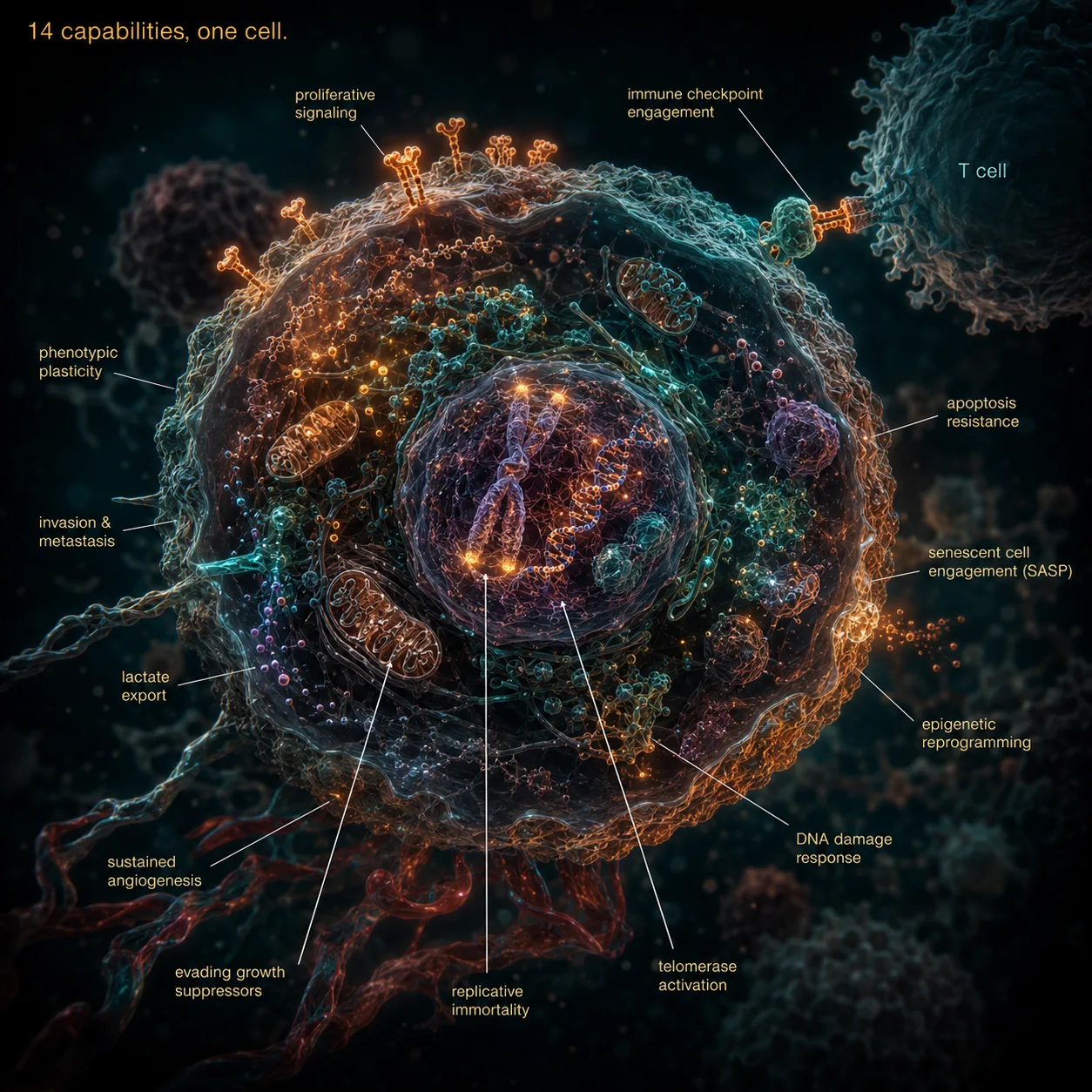
The first post in this series introduced the Hallmarks of Cancer as a list of 14 capabilities. That framing is accurate and useful — but it misses something.
The hallmarks aren't independent. A cancer cell doesn't acquire the ability to grow, then separately acquire the ability to survive, then separately acquire a blood supply, as if checking items off a list. These capabilities reinforce each other. The same signaling pathway that drives proliferation (#1) is often what disables the growth brakes (#2). The metabolic shift that fuels rapid division (#7) acidifies the tumor environment and suppresses the immune cells that should be killing it (#8). Genome instability (#9) generates the variation that enables every other hallmark to emerge faster.
The hallmarks are a system. And reading them as one changes what you notice.
Five clusters, one story
Grouped by what they share, the 14 hallmarks collapse into five natural clusters — five chapters of the same story.
Definition(Why grouping reveals structure)
Individual hallmarks answer "what can this cancer cell do?" Grouped hallmarks answer "how does cancer work?" — showing the internal logic, the dependencies between capabilities, and the order in which a tumor tends to build itself. The groupings aren't arbitrary; they reflect shared mechanisms, shared therapeutic targets, and shared conceptual territory.
Cell Autonomy (#1–4) — The foundation. A normal cell needs external permission to grow, to stop, and to die. The first four hallmarks describe a cell that gradually strips away every one of those dependencies: it generates its own growth signals, ignores inhibitory signals, disables its death machinery, and removes the division limit imposed by telomere shortening. These four don't happen in isolation — they're mutually reinforcing. Acquiring autonomous growth signaling triggers a protective response (oncogene-induced senescence) that forces the cell to simultaneously disable its death and arrest machinery. They come as a package.
Building the Tumor (#5–6) — The scale-up. Once a cell is self-sufficient, physics constrains it: cells more than ~2mm from a capillary can't get oxygen. Angiogenesis — recruiting new blood vessels — solves the supply problem. Invasion and metastasis solve the containment problem, allowing the disease to spread beyond the original tissue. These two are linked more tightly than they appear: the leaky tumor vasculature that angiogenesis creates is the same physical route cancer cells use to enter the bloodstream and metastasize.
The Enabling Characteristics (#9–10) — The accelerants. Genome instability and tumor-promoting inflammation don't give the tumor a direct capability — they make acquiring all the other capabilities faster. Instability generates variation, giving natural selection more to work with. Inflammation pre-loads the microenvironment with growth signals, survival cues, and immune suppression that the tumor would otherwise have to evolve. These two sit outside the main hallmark list in the framework precisely because they amplify everything else.
Metabolism and Immunity (#7–8) — The host relationship. The 2011 additions brought in the body around the tumor. How the tumor feeds itself (the Warburg effect and metabolic reprogramming) and how it hides from or disables the immune system turn out to be deeply connected — the metabolic waste product of aerobic glycolysis (lactate) acidifies the local environment and directly suppresses T cell function. The same tumor that rewires its metabolism to grow faster is, as a side effect, poisoning the immune response trying to destroy it.
The 2022 Hallmarks (#11–14) — The ecological turn. Phenotypic plasticity, epigenetic reprogramming, polymorphic microbiomes, senescent cells. The most recent additions share a common orientation: they describe the tumor not as a collection of mutant cells but as a living system in dynamic relationship with its environment. Cell identities shift. The epigenetic landscape gets rewritten without a single sequence change. Microbes living inside the tumor metabolize chemotherapy drugs. Senescent stromal cells nurture or suppress neighboring cancer cells depending on timing. The tumor is an ecosystem.
How the clusters depend on each other
The clusters aren't sequential stages — they're layers that compound:
Intuition(The dependency chain)
Genome instability (#9) accelerates the acquisition of hallmarks #1–4 by generating mutations faster. Tumor-promoting inflammation (#10) provides hallmarks #5, #6, #7, and #8 as environmental conditions before the cancer cell has evolved them intrinsically. Once established, the metabolic reprogramming of #7 feeds immune evasion of #8 through lactate acidification. Phenotypic plasticity (#11) and epigenetic reprogramming (#12) allow the tumor to respond to therapy without new mutations — the cellular equivalent of changing shape to avoid a net. Each layer makes the tumor harder to treat not just because there's more to target, but because the hallmarks are now working together.
This is also why single-agent targeted therapy almost always produces resistance: you can block one node in one hallmark, but the tumor has built redundancy across the system. The cancer that was sensitive to the EGFR inhibitor finds an alternative proliferative route (#1), or switches lineage to one where EGFR doesn't matter (#11), or recruits macrophages to provide the growth factors it can no longer self-generate (#10).
Durable responses come from interventions that disrupt the system — combining mechanisms across clusters, or targeting the enabling characteristics that feed everything else.
What to read here
Each post in this section covers one of the five clusters in depth — not just what each hallmark does, but how the hallmarks within a cluster are mechanistically linked, and how the cluster connects to the others:
- Cell Autonomy: Hallmarks #1–4
- Building the Tumor: Hallmarks #5–6
- The Enabling Characteristics: Hallmarks #9–10
- Metabolism and Immunity: Hallmarks #7–8
- The Ecological Turn: Hallmarks #11–14
If you want to go deeper on any individual hallmark, the per-hallmark posts cover each one from first principles.
Summary(Summary)
The 14 Hallmarks of Cancer are not independent capabilities — they are a system. Grouped into five clusters (cell autonomy, tumor expansion, enabling characteristics, metabolism and immunity, and the 2022 ecological hallmarks), the dependencies and interactions between them become visible in a way the individual list cannot show. Understanding this structure is what changes how you think about treatment: not "block the hallmark," but "disrupt the system."