Recall(Hallmarks #11–14)
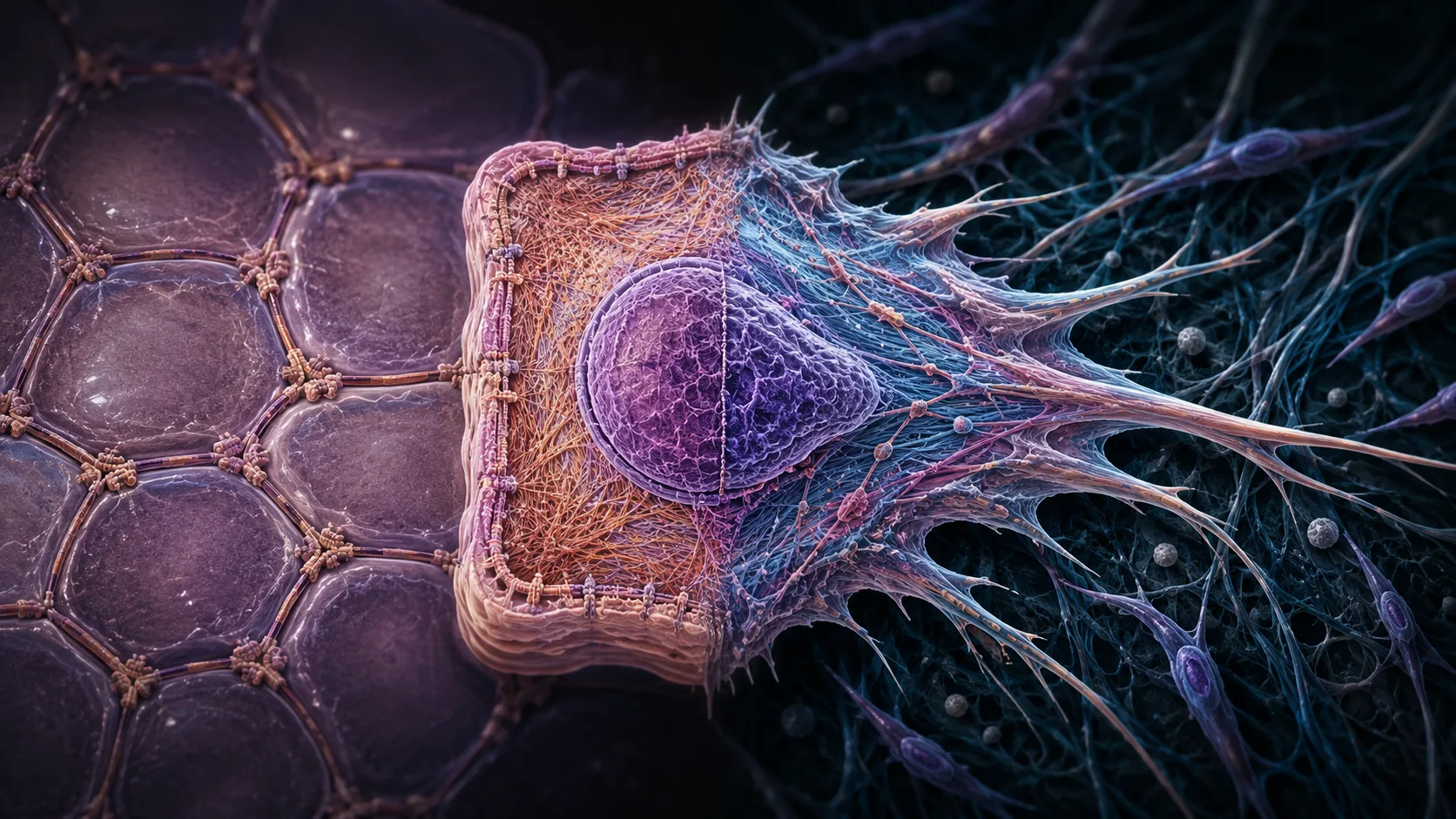
Unlocking phenotypic plasticity (#11), nonmutational epigenetic reprogramming (#12), polymorphic microbiomes (#13), senescent cells (#14). All four from Hanahan's 2022 update. These are the most recent additions to the framework, and they share something the earlier hallmarks don't: they describe the tumor as a dynamic system in relationship with its environment, not just a collection of cells with altered properties.
The original six hallmarks described properties of the cancer cell. The 2011 additions brought in the host — metabolism and immunity. The 2022 additions go further: they describe the tumor as an entity whose biology cannot be fully specified without specifying its microenvironmental, microbial, and epigenetic context. The tumor is not a thing; it is a relationship.
This is not just a philosophical reframe. It has concrete mechanistic implications — and therapeutic ones.
The shared logic
Before taking them one by one, the pattern these four share is worth naming:
All four are reversible. Phenotypic states can switch back. Epigenetic marks can be rewritten. The microbiome can be modified. Senescent cells can be cleared or their secretion suppressed. Unlike mutations, none of these changes is permanent. This is why epigenetic therapy, senolytics, FMT, and differentiation-inducing approaches are plausible in ways that "reverse the mutation" is not.
All four are context-dependent. Phenotypic plasticity is harmful when it generates therapy-resistant stem-like states and helpful when differentiation therapy re-engages it. Epigenetic reprogramming silences tumor suppressors and also sensitizes tumors to epigenetic inhibitors. The microbiome can promote carcinogenesis (H. pylori) or enhance immunotherapy response (responder-associated gut bacteria). Senescent cells suppress early lesions and promote late-stage progression. None of these is simply "bad" — all depend on timing, location, and cellular composition.
All four represent the tumor exploiting or disrupting normal regulatory systems. The developmental transcription factors cancer re-activates in phenotypic plasticity exist because the body needs cell state flexibility during development. The epigenetic landscape cancer rewrites was built to maintain appropriate cell identity. The microbiome co-opted into promoting tumors evolved in partnership with the immune system. Senescent cells arose as a tumor-suppressive mechanism. Cancer doesn't invent new biology — it corrupts existing biology.
The shape-shifting cell
The cancer stem cell hypothesis — that a subset of cells within a tumor can self-renew and regenerate the full tumor heterogeneity — was long assumed to describe a fixed hierarchy. Single-cell transcriptomics revealed something more dynamic: cancer stem cell (CSC) and non-CSC populations interconvert, driven by microenvironmental signals (hypoxia, Wnt, Notch, Hedgehog, TGF-β). The hierarchy is real but fluid.
The clinical manifestation of phenotypic plasticity is therapy-induced lineage switching: prostate cancer under sustained AR pathway inhibition transitions to a neuroendocrine phenotype, losing AR expression and becoming insensitive to the drugs that drove the pressure. EGFR-mutant lung cancers can switch to small cell phenotypes under osimertinib. The tumor is not evolving genetically — it is changing identity to escape the mechanism of the therapy.
The same transcription factors that drive EMT (SNAIL, TWIST, ZEB1/2 — repurposed from embryonic development) also confer stem-like properties and therapy resistance. This is why EMT-high tumors tend to be both more invasive (#6) and more therapy-resistant — plasticity and invasiveness are mechanistically coupled.
Rewriting the annotations
The genome is the same in every cell in the body. What makes a liver cell a liver cell and a neuron a neuron is the epigenome — the layer of DNA methylation, histone modifications, and chromatin architecture that determines which genes are accessible.
Cancer rewrites this layer without necessarily touching the DNA sequence underneath:
- Promoter CpG hypermethylation silences tumor suppressors (MLH1, CDH1, CDKN2A, BRCA1) in the absence of coding mutations — an epigenetic two-hit
- KMT2D loss collapses the enhancer landscape in lymphoma, silencing gene programs downstream of H3K4me1-marked enhancers without a single additional coding mutation
- EZH2 gain-of-function spreads H3K27me3 repression genome-wide, locking cells in undifferentiated states
- IDH mutations produce 2-HG, which inhibits TET demethylases and histone demethylases, creating global hypermethylation — a direct bridge to hallmark #7 (metabolism)
The reversibility of epigenetic states is the rationale for an entire therapeutic class: EZH2 inhibitors (tazemetostat), HDAC inhibitors, DNA methyltransferase inhibitors (azacitidine, decitabine), BET bromodomain inhibitors. These don't kill cells by blocking a proliferative signal — they attempt to reset the regulatory landscape that cancer had corrupted.
Intuition(Epigenetics and plasticity are the same problem)
Hallmarks #11 and #12 are separable mechanistically — phenotypic plasticity describes state transitions, epigenetic reprogramming describes the molecular mechanism of those transitions. But they are deeply coupled: the state transitions of phenotypic plasticity are executed through epigenetic changes. The cancer stem cell state is defined by an epigenetic configuration; the transition to a differentiated state is epigenetic rewriting. The lineage switch under therapy pressure is an epigenetic reprogramming event. Treating them as separate hallmarks is useful for precision, but the underlying biology is unified — cell identity is epigenetic, and cancer's manipulation of cell identity is epigenetic manipulation.
The microbial factor
The tumor microenvironment includes organisms. Fusobacterium nucleatum is found enriched in colorectal cancer tissue, activates Wnt/β-catenin in colon epithelium, recruits tumor-promoting immune cells, and can travel with metastases to the liver. Gammaproteobacteria within pancreatic tumors express a cytidine deaminase that inactivates gemcitabine directly. Gut microbiome composition predicts and causally influences checkpoint inhibitor response — fecal microbiota transplant from responders has produced responses in previously anti-PD-1-resistant melanoma patients.
The microbiome hallmark represents the outer edge of the ecological framing: the tumor is not just in dynamic relationship with the human cells around it, but with the microbial communities that co-exist within it.
The three mechanisms are distinct and therapeutically relevant at different timescales:
- Carcinogenic microorganisms (H. pylori, EBV, HPV) — interventions here are preventive: eradication, vaccination
- Intratumoral drug metabolism — bacteria inactivating chemotherapy — potential target for antibiotic co-treatment
- Gut microbiome-immune axis — modulation via FMT, probiotics, dietary intervention to improve immunotherapy response
Zombie cells in the stroma
Cellular senescence is the clearest example of context-dependency in the 2022 hallmarks. The same biological state — permanent growth arrest with active SASP secretion — is:
- Tumor-suppressive early: oncogene-induced senescence (OIS) removes pre-cancerous cells from the cycling pool; SASP recruits immune cells to clear them
- Tumor-promoting late: therapy-induced senescent (TIS) cells and senescent stromal cells secrete IL-6, VEGF, MMPs, and HGF that support residual tumor cells, promote immune suppression, and drive paracrine EMT in neighboring cancer cells
The SASP is also the bridge to hallmark #10 (inflammation) — senescent cells are a cellular source of the pro-inflammatory secretion that constitutes tumor-promoting inflammation. Clearing senescent cells (senolytics: dasatinib+quercetin, navitoclax) or suppressing their SASP (senomorphics: ruxolitinib, rapamycin) is therefore simultaneously an anti-senescence and an anti-inflammatory intervention.
The timing problem is real: senolytic therapy that clears OIS cells early in carcinogenesis removes a tumor-suppressive barrier. Senolytic therapy that clears TIS cells after treatment may reduce SASP-driven relapse. The same intervention, at different time points, could help or harm.
The unified picture
Read together, hallmarks #11–14 describe the same insight from four angles: cancer's biology cannot be fully specified without its context. The cancer cell's identity is not fixed (plasticity); its gene expression is determined by an epigenomic layer that can be rewritten (epigenetic reprogramming); its responses depend on the microbial community it co-exists with (microbiome); and the senescent cells in its vicinity determine whether its microenvironment is suppressive or permissive (senescent cells).
This has a practical implication: interventions that target these hallmarks must be context-sensitive in a way that targeting a proliferative kinase is not. Blocking RAS signaling is straightforwardly anti-tumor. Manipulating the epigenome, the microbiome, or senescent cell populations involves regulatory systems that are context-dependent by design. The therapeutic window requires knowing not just which target to hit, but when and in what combination.
Summary(Summary)
The 2022 hallmarks — phenotypic plasticity, epigenetic reprogramming, polymorphic microbiomes, senescent cells — share three properties that set them apart from earlier hallmarks: they are reversible, they are context-dependent, and they represent cancer corrupting existing regulatory systems rather than inventing new ones. Phenotypic plasticity and epigenetic reprogramming are mechanistically unified — cell state transitions are executed through epigenomic changes. The microbiome hallmark extends the ecological view to include microbial participants in tumor biology. Senescent cells are the most context-dependent of all — tumor-suppressive in OIS, tumor-promoting when accumulated in the established TME. Together, these four hallmarks represent the framework's most important conceptual evolution: the tumor as an ecosystem, not just a cell.