Recall(Hallmarks #7–8)
Reprogramming cellular metabolism (#7) and avoiding immune destruction (#8). Both added in 2011, when the evidence had accumulated enough to call them universal features of malignancy. These two brought the host-tumor relationship into the center of the framework for the first time — asking not just what the cancer cell does internally, but how it interacts with the body it's living in.
The original six hallmarks were almost entirely cell-intrinsic: properties of the cancer cell itself. Hallmarks #7 and #8 are the first to bring the host-tumor relationship into the center of the framework. How the tumor feeds itself is a question about how the cancer cell interacts with the biochemical environment of the body. How the tumor hides from immune surveillance is a question about how the cancer cell interacts with the cellular environment of the body.
Grouped together, they reveal something the framework's sequential numbering obscures: these two hallmarks are deeply mechanistically entangled. Metabolic reprogramming shapes immune function. Immune suppression shapes metabolic conditions. The tumor microenvironment is where both play out simultaneously.
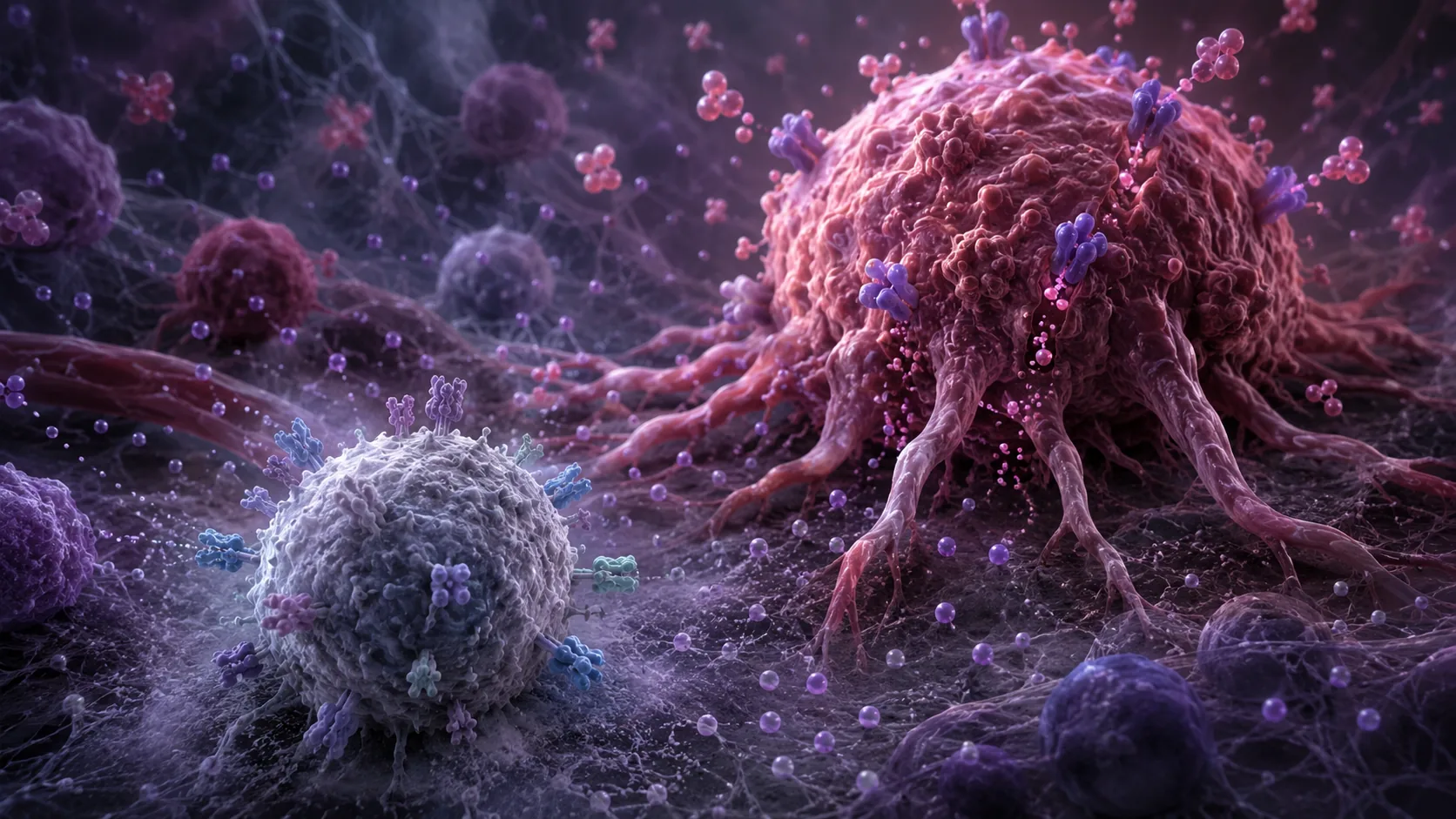
What the Warburg effect is actually for
Otto Warburg's 1924 observation — that cancer cells ferment glucose to lactate even in the presence of oxygen — was accurate but misinterpreted for decades. It looked like metabolic dysfunction. It is metabolic optimization for a specific goal: rapid biomass production.
A dividing cell doesn't primarily need ATP. It needs carbon skeletons for new membranes, nucleotides for new DNA, amino acids for new proteins. Full glucose oxidation through the TCA cycle and OXPHOS is maximally efficient at generating ATP, but it burns all the carbon to CO₂. Aerobic glycolysis is less ATP-efficient but routes glucose carbon into the pentose phosphate pathway (ribose-5-phosphate for nucleotides, NADPH for lipid synthesis and antioxidant defense) and other biosynthetic branches. The Warburg effect is a trade: burn less carbon for energy, use more for building.
This reprogramming is directly downstream of the oncogenic signaling alterations in hallmarks #1 and #2:
- RAS/PI3K/AKT/mTOR upregulate glucose transporter expression (GLUT1, GLUT3) and hexokinase activity; mTOR activates HIF-1α even under normoxia, driving the glycolytic gene program
- MYC transcriptionally activates virtually every glycolytic enzyme and drives glutaminolysis — the parallel catabolism of glutamine as a carbon and nitrogen source
- p53 loss removes suppression of glycolysis and promotes a shift away from OXPHOS
Definition(The IDH exception)
Not all metabolic reprogramming fits the Warburg template. IDH1/2 mutations — found in ~80% of lower-grade gliomas and ~20% of AML cases — give the enzyme a neomorphic activity: producing 2-hydroxyglutarate (2-HG), an oncometabolite that competitively inhibits αKG-dependent dioxygenases including TET DNA demethylases and histone demethylases. The result is global epigenetic hypermethylation — a direct bridge between metabolic reprogramming (#7) and epigenetic reprogramming (#12). IDH inhibitors (ivosidenib, enasidenib, vorasidenib) block 2-HG production and partially restore differentiation programs.
The immune system that should have won
Most nascent cancer cells are detected and destroyed by the immune system before they establish a tumor. The cancers that develop are — by selection — the ones that evaded this surveillance.
The primary executioner is the cytotoxic T cell, which recognizes tumor-specific peptides (neoantigens, cancer-testis antigens) presented on MHC class I. Tumors evade in several ways:
- Downregulating MHC class I expression (B2M loss, antigen processing machinery silencing) — hiding
- Upregulating PD-L1 — switching off T cells that do arrive
- Recruiting Tregs, MDSCs, and M2 macrophages — building immunosuppressive infrastructure
- Expressing CD47 — blocking phagocytosis and NK killing
Checkpoint inhibitors — anti-PD-1, anti-PD-L1, anti-CTLA-4 — work by restoring T cell function that the tumor had suppressed. Their remarkable clinical success in a fraction of patients demonstrates that immune evasion is a real hallmark, not a theoretical one; restoring immune recognition can produce complete and durable responses.
Why they're the same problem
Metabolism and immunity are linked in the tumor microenvironment through mechanisms that make them impossible to fully separate:
Lactate acidifies the TME. Aerobic glycolysis produces lactate and protons that are exported into the extracellular space, dropping local pH to 6.5–6.9. T cells and NK cells are functionally impaired at low pH — their cytotoxic activity, proliferation, and cytokine production are all reduced in acidic conditions. The metabolic waste product of hallmark #7 is directly immunosuppressive, providing partial immune evasion (hallmark #8) without any additional mutation.
Metabolic competition suppresses T cells. Tumor cells and T cells compete for the same nutrients — glucose and glutamine — within the confined space of the TME. Glucose-starved T cells have impaired TCR signaling, reduced effector function, and increased apoptosis. The tumor's metabolic dominance literally starves the immune response.
IDO1 depletes tryptophan. Many tumors express IDO1 (indoleamine 2,3-dioxygenase), which catabolizes tryptophan — an amino acid T cells require for function and protein synthesis. IDO1 is often induced by IFN-γ from infiltrating T cells themselves, creating a perverse feedback: T cell infiltration triggers the metabolic suppression of the same T cells.
Example(Why checkpoint inhibitors fail in metabolically hostile TMEs)
Checkpoint inhibitors release the brake on T cells — but if the T cells that arrive in the tumor are immediately metabolically suppressed by glucose deprivation, lactate acidification, and tryptophan depletion, the released brake doesn't help much. This is one explanation for why checkpoint inhibitors work well in some tumor types (melanoma, MSI-high colorectal cancer) and poorly in others (pancreatic cancer, prostate cancer) — the metabolic hostility of the TME in low-responder tumor types may be limiting T cell function beyond what checkpoint blockade can rescue. Combining checkpoint inhibitors with interventions that restore TME metabolic fitness (buffer pH, block IDO1, target glutamine competition) is an active research direction.
Hypoxia links both. HIF-1α — the master regulator of the hypoxic response — drives VEGF (angiogenesis, #5), metabolic glycolysis (#7), and immune suppression (#8) simultaneously. In hypoxic tumor regions, HIF-1α in TAMs drives M2-like polarization; HIF-1α in tumor cells upregulates PD-L1 expression; HIF-1α drives the lactate export that acidifies the space and suppresses T cells. A single transcription factor activated by a physical constraint of the tumor (insufficient oxygen) simultaneously advances three hallmarks.
The therapeutic interface
The entanglement of metabolism and immunity opens therapeutic approaches that neither hallmark alone would suggest:
- Metformin (complex I inhibitor) reduces tumor cell OXPHOS, but its most interesting cancer effect may be metabolic reprieve for T cells — reducing glucose competition and partially restoring TME metabolic balance
- IDO1 inhibitors (epacadostat, linrodostat) were designed as immune checkpoint enhancers; trials combining IDO1 inhibition with PD-1 blockade showed disappointing results in unselected patients, but the biology of IDO1-high tumors remains an active target
- Bicarbonate buffer + immunotherapy — pre-clinical data showing that neutralizing TME acidity restores T cell function and improves checkpoint inhibitor response; clinical trials ongoing
- MCT4 inhibitors — blocking lactate export directly to reduce TME acidification and immune suppression
Summary(Summary)
Hallmarks #7 and #8 brought the tumor-host relationship into the center of the framework. Metabolic reprogramming (Warburg effect, glutaminolysis, oncometabolites) is not dysfunction but optimization for biomass production — directly downstream of the oncogenic signaling alterations in hallmarks #1 and #2. Immune evasion (MHC downregulation, checkpoint exploitation, immunosuppressive microenvironment) is what allowed the tumor to escape the surveillance that destroys most pre-cancerous cells. These two hallmarks are mechanistically entangled in the TME: lactate acidification, glucose/glutamine competition, IDO1-driven tryptophan depletion, and HIF-1α-driven suppression of both immune cell function and metabolic flexibility all link metabolic reprogramming directly to immune evasion. The most promising frontier at this interface is combination approaches that restore TME metabolic conditions alongside immune checkpoint release.