Cancer is not one disease. There are over 100 distinct types, arising in different tissues, driven by different mutations, following different clinical courses. A pediatric brain tumor and a pancreatic adenocarcinoma in a 70-year-old share almost nothing in their origin, genetics, or treatment.
Except the biology underneath.
In 2000, Douglas Hanahan and Robert Weinberg asked what all cancers have in common — not in terms of where they appear, but in terms of what a normal cell has to become to turn malignant. Their answer became one of the most cited papers in the history of biology.
The framework
The Hallmarks of Cancer are a set of functional capabilities that cells systematically acquire on the path from normal to malignant. Not a checklist of mutations, not a catalog of gene names — a description of what a cancer cell must be able to do.
Definition(Hallmarks of Cancer)
Functional capabilities acquired by cells during tumor development that enable them to grow, survive, invade, and spread. First described by Hanahan and Weinberg in Cell (2000), updated in 2011 and 2022. The current framework has 14 hallmarks total — six original, two added in 2011 with two enabling characteristics, and four more in 2022.
The framework has been updated twice since 2000. Not because the original was wrong — but because the field kept learning. Each expansion reflects a shift in what oncologists and researchers understood about how cancer works: first cell-intrinsic properties, then metabolic and immune dimensions, then ecological ones. The progression from 6 to 14 hallmarks tracks 22 years of the field maturing.
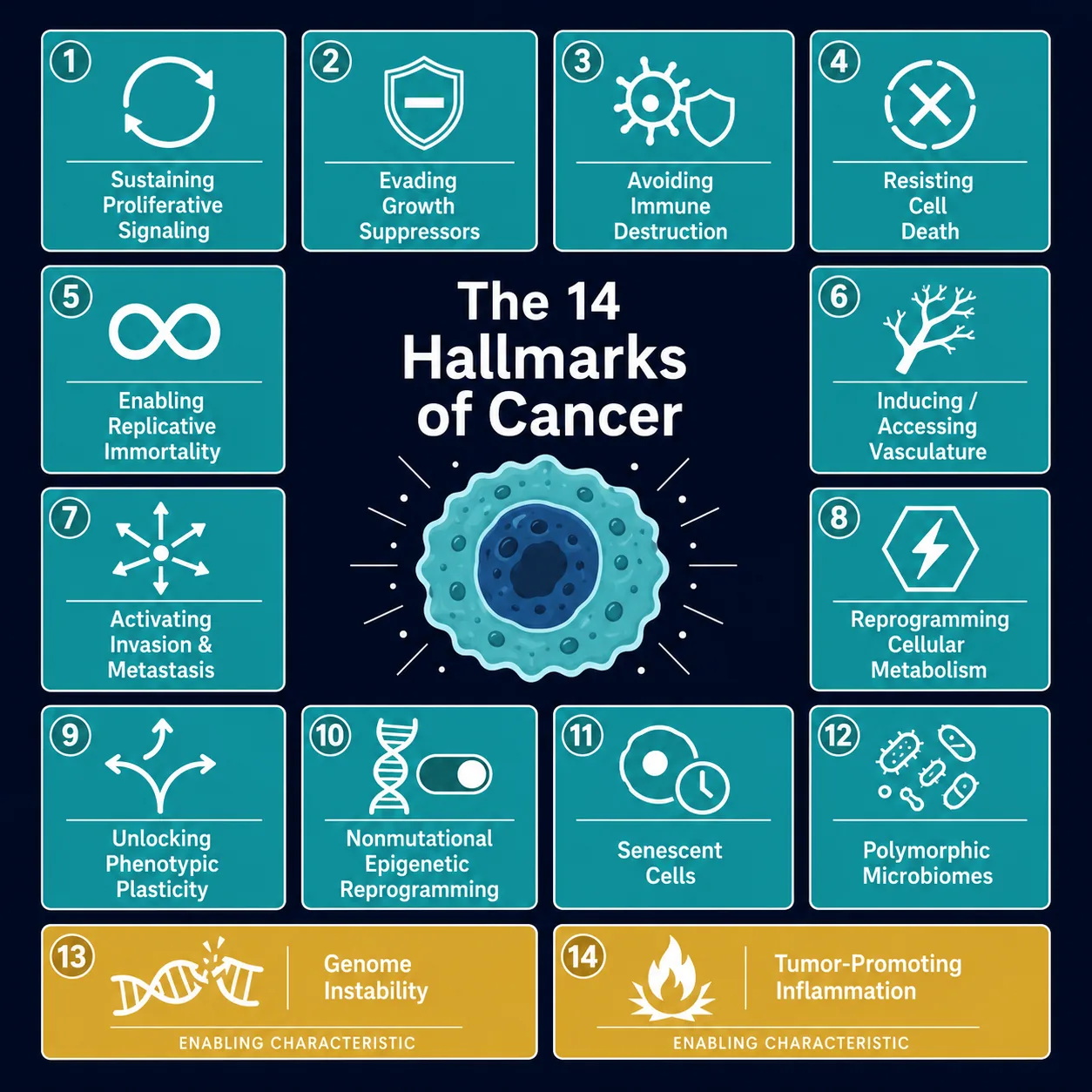
The 14 hallmarks
| # | Hallmark | Added |
|---|---|---|
| 1 | Sustaining proliferative signaling | 2000 |
| 2 | Evading growth suppressors | 2000 |
| 3 | Resisting cell death | 2000 |
| 4 | Enabling replicative immortality | 2000 |
| 5 | Inducing angiogenesis | 2000 |
| 6 | Activating invasion and metastasis | 2000 |
| 7 | Reprogramming cellular metabolism | 2011 |
| 8 | Avoiding immune destruction | 2011 |
| 9 | Genome instability and mutation (enabling) | 2011 |
| 10 | Tumor-promoting inflammation (enabling) | 2011 |
| 11 | Unlocking phenotypic plasticity | 2022 |
| 12 | Nonmutational epigenetic reprogramming | 2022 |
| 13 | Polymorphic microbiomes | 2022 |
| 14 | Senescent cells | 2022 |
Hallmarks #9 and #10 are labeled enabling characteristics — they don't directly confer growth or spread, but they accelerate the acquisition of every other hallmark. Genome instability is the engine that generates the mutations; tumor-promoting inflammation is the environment that amplifies them.
Why this matters more than you'd expect
Before this framework, cancer biology was a sprawling collection of disconnected observations. Individual genes, individual pathways, individual tumor types. The literature was enormous and getting harder to synthesize.
The hallmarks gave the field a shared vocabulary. More importantly, they gave it a structure: if you know what a cancer cell must achieve, you know what to look for and what to target. Every meaningful targeted therapy developed in the last 25 years maps onto one of these hallmarks.
Intuition(Why the same drugs keep failing)
If you block one hallmark, the tumor finds another path to the same capability. BRAF inhibitors in melanoma produce dramatic initial responses; resistance emerges when the tumor rewires around the blocked node, often through the same pathway. The hallmarks framework predicts this: you are attacking a capability, not the cell. Durable control requires attacking multiple hallmarks simultaneously — which is why combination therapy is the rule, not the exception, in modern oncology.
How this series is structured
Each post covers one hallmark: what it is, the mechanisms behind it, and what studying it looks like in a lab or clinic. The series follows the framework's order — the six original hallmarks first, then the 2011 additions, then the 2022 emerging hallmarks.
Note
Posts #07, #08, and #12 connect directly to research I worked on. The metabolic paper (HDAC6 inhibition) sits in hallmark #07. The three immune evasion papers (Atf7ip, TSC1/TSC2, Nemvaleukin) are all variations on hallmark #08. The KMT2D paper is hallmark #12 made concrete. A separate series will cover those papers in depth.
The series closes with a synthesis post that pulls cross-hallmark themes together — patterns that only become visible when all fourteen are in view.
Start wherever you want. But if you want the full logic, start with #01: how a cell learns to grow without being told to, and why that single capability is the entry point for almost everything else.
Summary(Summary)
Cancer is a structured acquisition of capabilities — not random damage, but a reproducible biological trajectory that different cell types in different people converge on through different mutations. The Hallmarks of Cancer framework distills a century of research into 14 functional traits shared by every malignant cell. Understanding each hallmark is understanding one piece of the machinery. This series covers all 14.