Recall(The most controversial 2022 addition)
Of the four hallmarks added in 2022, polymorphic microbiomes generated the most skepticism. Not because the underlying biology is doubtful — the evidence is solid — but because it blurs the boundary of what a "hallmark of cancer" means. The microbiome is not a cell-intrinsic property but an ecological relationship. Hanahan's argument was that this relationship is so consistently relevant to cancer biology that excluding it from the framework left too much unexplained.
Every surface and cavity of the human body is colonized by microorganisms — bacteria, fungi, archaea, viruses — that collectively form the microbiome. The gut alone harbors an estimated 10¹³ microbial cells, approximately matching the number of human cells in the body. These communities are not passive passengers: they metabolize compounds, train the immune system, produce signaling molecules, and are in continuous crosstalk with the epithelial barriers they colonize.
Their involvement in cancer is pervasive and mechanistically diverse.
Where the evidence actually is
The clearest causal relationships between microorganisms and cancer are the ones that meet Koch's postulates — organisms that can be identified in tumors, whose experimental introduction causes or promotes malignancy.
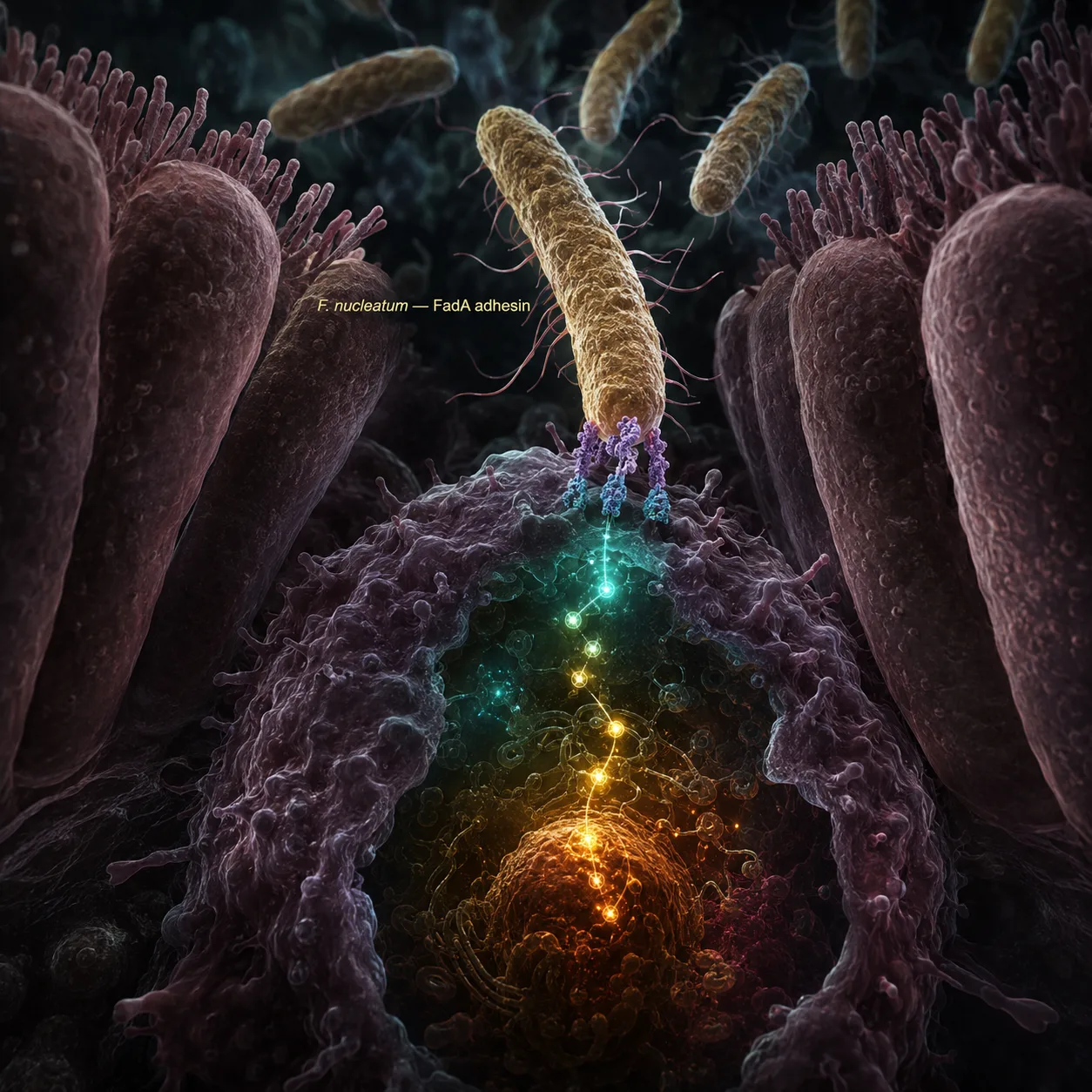
Fusobacterium nucleatum is an oral anaerobe found enriched in colorectal cancer tissue compared to adjacent normal mucosa, and its abundance correlates with stage, recurrence, and survival. F. nucleatum activates Wnt/β-catenin signaling in colon cells (through its adhesin FadA binding E-cadherin), promotes a pro-inflammatory microenvironment, recruits tumor-promoting immune cells, and can invade tumor cells to travel with metastases to the liver. Germ-free mice colonized with F. nucleatum develop more colorectal tumors in APC-mutant models.
Helicobacter pylori is the prototype: a bacterium so clearly causal in gastric cancer that eradicating it with antibiotics reduces gastric cancer risk — a rare example of cancer chemoprevention through antimicrobial therapy. H. pylori promotes gastric carcinogenesis through CagA-mediated activation of SHP2 and NF-κB, induction of chronic inflammation, and induction of chromosomal instability in gastric epithelium.
Porphyromonas gingivalis, another oral pathogen, has been found enriched in pancreatic cancer tissue and is associated with poor prognosis — intriguingly, oral bacteria reach the pancreas through the bloodstream or the duct system.
Definition(Intratumoral microbiome)
The microbial communities residing within tumor tissue itself — not just in the adjacent normal tissue or gut lumen. Studies using 16S ribosomal RNA sequencing and spatial metagenomics have established that viable bacteria, fungi, and their metabolites are present inside tumor cells and in the surrounding stroma. The composition is tumor-type-specific: Fusobacterium is enriched in colorectal and head/neck tumors, Malassezia (a fungus) in pancreatic cancer, Gammaproteobacteria in various solid tumors.
The gut microbiome and systemic immunity
The most clinically impactful microbiome-cancer connection in recent years is the relationship between gut microbiome composition and checkpoint inhibitor response.
Multiple clinical cohort studies have shown that patients who respond to anti-PD-1 therapy differ in gut microbiome composition from non-responders, and that the difference precedes treatment. The responder-associated microbiomes are enriched in bacteria that produce short-chain fatty acids (butyrate, propionate), maintain gut barrier integrity, and support effector T cell responses. Non-responder microbiomes are enriched in genera associated with gut dysbiosis, immune tolerance, and MDSC expansion.
Example(Fecal microbiota transplant and checkpoint inhibitor resistance)
Pilot clinical trials have attempted to convert non-responders to checkpoint inhibitors by performing fecal microbiota transplant (FMT) from responders before or during treatment. Early results from two studies in anti-PD-1-resistant metastatic melanoma showed that FMT from responders produced responses in a fraction of previously resistant patients, and expanded responder-like T cell populations in the gut and tumor. This is proof-of-concept that the gut microbiome causally modulates systemic anti-tumor immunity — not just correlates with it.
The mechanism runs through the gut immune axis: microbial metabolites (particularly butyrate through HDAC inhibition in T cells, and SCFA signaling through GPR receptors) modulate the activation state and tissue trafficking of T cells and dendritic cells systemically. Specific microbiome-derived signals are required for the development of type 17 responses and effector memory T cells that are most relevant to tumor immunosurveillance.
When bacteria eat your chemotherapy
One of the most surprising findings is that bacteria within tumors can directly metabolize chemotherapy drugs — inactivating them or converting them to toxic metabolites — potentially contributing to treatment resistance.
Gammaproteobacteria (including Mycoplasma hyorhinis) express a cytidine deaminase that can degrade gemcitabine, the backbone of pancreatic cancer chemotherapy. Pan et al. (2019) demonstrated that bacteria isolated from pancreatic tumors could inactivate gemcitabine in vitro, and that antibiotic co-treatment with ciprofloxacin restored gemcitabine sensitivity in mouse models. Bacteria expressing this enzyme were found in 76% of pancreatic tumor samples.
This reframes drug resistance in a completely different way: not as a property of the cancer cell, but as a property of the microbial community co-habiting the tumor.
Warning(Microbiome research: methodological cautions)
The microbiome field has known reproducibility challenges. Many early 16S rRNA studies suffered from contamination artifacts (bacteria in low-biomass samples are easily swamped by kit or environmental contaminants), small cohort sizes, and lack of mechanistic validation. The most robust findings (F. nucleatum in colorectal cancer, H. pylori in gastric cancer, FMT-immunotherapy interactions) are replicated across multiple independent cohorts with proper controls. The intratumoral microbiome in low-bacterial-biomass tumors (pancreatic, breast, lung) remains more contested. Read the methodology carefully before taking findings at face value.
Fungi in cancer
Beyond bacteria, intratumoral fungi have emerged as a distinct layer of the tumor microbiome. Narunsky-Haziza et al. (2022) performed pan-cancer fungal profiling across 35 cancer types (TCGA) and found tumor-type-specific fungal signatures: Malassezia in pancreatic ductal adenocarcinoma, Candida in lung and oral cancers, Aspergillus in stomach and esophageal cancers.
Whether fungal signatures are drivers or passengers is less clear than for bacteria, but Malassezia in pancreatic cancer has been shown to promote tumor progression in mouse models — potentially through mannose-binding lectin complement activation.
NF-κB as a bridge
The mechanistic bridge between microbiome signals and tumor biology is often NF-κB — the same transcription factor central to hallmark #10 (inflammation). Microbial products (LPS, flagellin, peptidoglycan) activate pattern recognition receptors (TLRs, NLRs) on tumor cells and stromal cells, driving NF-κB-dependent expression of inflammatory cytokines, survival signals, and immune modulatory factors. This is why tumor-promoting bacteria and tumor-promoting inflammation are mechanistically linked: the microbiome is one of the inputs into the inflammatory program.
Summary(Summary)
The polymorphic microbiome hallmark reflects evidence that microbial communities — in the gut, the tumor, and on mucosal surfaces — actively participate in cancer biology through at least three distinct mechanisms: direct carcinogenic effects (H. pylori, F. nucleatum activating Wnt and NF-κB), modulation of systemic and intratumoral immune tone (gut microbiome composition predicting and causally modulating checkpoint inhibitor response), and drug metabolism (bacterial cytidine deaminase inactivating gemcitabine in pancreatic cancer). The most clinically actionable insights are the H. pylori eradication-cancer prevention story and the emerging FMT-immunotherapy combinations. The intratumoral microbiome in low-biomass tumors remains methodologically challenging but is an active frontier — the field is maturing rapidly with improved decontamination methods and spatial metagenomics approaches.