Recall(An enabling characteristic)
Hallmarks #9 and #10 are categorized differently from the others — they are enabling characteristics rather than functional capabilities. They don't directly allow a tumor to grow or spread, but they accelerate the acquisition of every other hallmark. Genome instability is the engine that generates the mutations the other hallmarks depend on.
Every time a cell divides, it copies 6 billion base pairs of DNA. The error rate of DNA polymerase alone would generate thousands of mutations per division — except that cells run multiple layers of proofreading and repair that bring the actual mutation rate down to roughly 1–2 errors per cell division.
Cancer doesn't achieve its mutational burden by running the normal system faster. It achieves it by breaking the repair systems — turning the genome from a carefully maintained archive into something closer to a first draft that never gets edited.
Why mutations accumulate faster in cancer
The somatic mutation rate in normal cells is low enough that acquiring the multiple driver mutations needed for malignancy over a lifetime is unlikely — but not impossible. Cancer accelerates this by disabling the mechanisms that catch and fix errors:
Mismatch repair (MMR) corrects base mismatches and small insertions/deletions that escape polymerase proofreading. MLH1, MSH2, MSH6, and PMS2 are the core MMR proteins. Loss of MMR function — through germline mutation (Lynch syndrome), somatic mutation, or epigenetic silencing of MLH1 — leads to microsatellite instability (MSI), a characteristic pattern of length variation at repetitive DNA sequences throughout the genome.
Definition(Microsatellite instability (MSI))
A condition of widespread replication errors at microsatellite sequences — short tandem repeats scattered throughout the genome — caused by deficient mismatch repair. MSI-high tumors carry hundreds to thousands of frameshift mutations and are typically hypermutated. MSI status has become clinically important because MSI-high tumors respond particularly well to PD-1 checkpoint inhibitors, regardless of tumor type — the first tumor-agnostic FDA approval (pembrolizumab, 2017) was based on this observation.
Base excision repair (BER) corrects oxidative damage, deamination of cytosine to uracil, and alkylation damage. PARP1 is a key sensor in BER that detects single-strand breaks and recruits repair machinery. PARP inhibitors exploit BER — in cells with deficient homologous recombination (BRCA1/2-mutant), blocking PARP prevents repair of single-strand breaks, which collapse into double-strand breaks that the cell can't fix.
Nucleotide excision repair (NER) removes bulky DNA adducts — the kind caused by UV radiation and chemical carcinogens. XPC, XPA, ERCC1/2 are core NER components. Germline NER defects cause xeroderma pigmentosum, a condition of extreme UV sensitivity and dramatically elevated skin cancer risk.
Homologous recombination (HR) repairs double-strand breaks accurately, using the sister chromatid as a template. BRCA1 and BRCA2 are central HR components — they coordinate resection of break ends and recruitment of RAD51, which performs the strand invasion step. HR deficiency leads to reliance on error-prone repair pathways and is the vulnerability exploited by PARP inhibitors.
Non-homologous end joining (NHEJ) repairs double-strand breaks quickly but imprecisely — it religates broken ends without a template, often introducing small insertions or deletions. NHEJ is the dominant DSB repair pathway in G1 phase; it's inherently mutagenic.
Mutational signatures: reading how the genome broke
One of the most powerful insights from large-scale cancer genomics is that different sources of DNA damage leave characteristic patterns in the mutation spectrum. These mutational signatures can be read from a tumor's genome to infer the processes that generated its mutations.
Definition(Mutational signatures)
Characteristic patterns of somatic mutation — defined by the type of base substitution and the flanking nucleotide context — that reflect the activity of specific mutational processes. Catalogued by the COSMIC Mutational Signatures database (v3.3: 79 single-base substitution signatures). Each signature represents a distinct biological process leaving a distinctive imprint on the genome.
| Signature | Process | Cancer context |
|---|---|---|
| SBS1 | Deamination of methylated cytosine (clock-like, age-related) | Universal — present in nearly all cancers |
| SBS2/13 | APOBEC cytidine deaminase activity | Breast, lung, bladder, cervical cancers |
| SBS4 | Tobacco smoke (C>A transversions at GpCpX) | Lung cancer in smokers |
| SBS6/15/20 | Mismatch repair deficiency | MSI-high colorectal, endometrial, gastric |
| SBS7a/b | UV radiation (C>T at dipyrimidines) | Melanoma, skin cancers |
| SBS8 | Unknown etiology (possible NER deficiency) | Many cancer types |
| SBS3 | Homologous recombination deficiency | BRCA1/2-mutant breast, ovarian, pancreatic |
The APOBEC signatures (SBS2/13) deserve special mention — they have emerged as one of the most prevalent mutational processes in cancer, found in over 50% of tumor types. APOBEC enzymes are cytidine deaminases that normally mutate viral DNA as part of innate immunity. In cancer, dysregulated APOBEC activity attacks the tumor's own genome, generating clustered C>T and C>G mutations, often in regions of single-stranded DNA exposed during replication.
Example(Kataegis and chromothripsis)
Two dramatic forms of genomic instability have been characterized by whole-genome sequencing. Kataegis is clustered hypermutation — hundreds of mutations concentrated in a small genomic region, typically APOBEC-driven at single-stranded DNA near double-strand breaks. Chromothripsis is catastrophic chromosomal rearrangement — a single chromosome (or a few) is shattered into dozens of pieces and randomly reassembled, generating complex rearrangements in a single event rather than gradually. Chromothripsis can simultaneously amplify oncogenes and delete tumor suppressors, compressing what might otherwise take years of evolution into a single cell division.
The mutator phenotype
Lowell Loeb proposed the mutator phenotype hypothesis: cancer cells acquire early mutations that compromise DNA repair fidelity, which then accelerates the rate of all subsequent mutation accumulation. The early loss of a repair gene is not itself a driver of growth — but it dramatically increases the probability of acquiring subsequent driver mutations.
This predicts that early carcinogenesis involves a period of elevated mutation rate before any of the growth-promoting hallmarks are strongly established. Evidence from clonal evolution studies supports this — large mutational bursts are detectable in early neoplastic lesions.
Intuition(Genomic instability as a double-edged sword)
High mutation rates accelerate the acquisition of cancer hallmarks — but they also generate neoantigens (fragmentary proteins from mutated sequences) that the immune system can recognize. This is why hypermutated MSI-high tumors respond so well to checkpoint inhibitors: the very instability that drove their malignant evolution also made them immunologically visible. Paradoxically, the most genomically unstable tumors can be among the most immunotherapy-responsive.
Chromosomal instability (CIN)
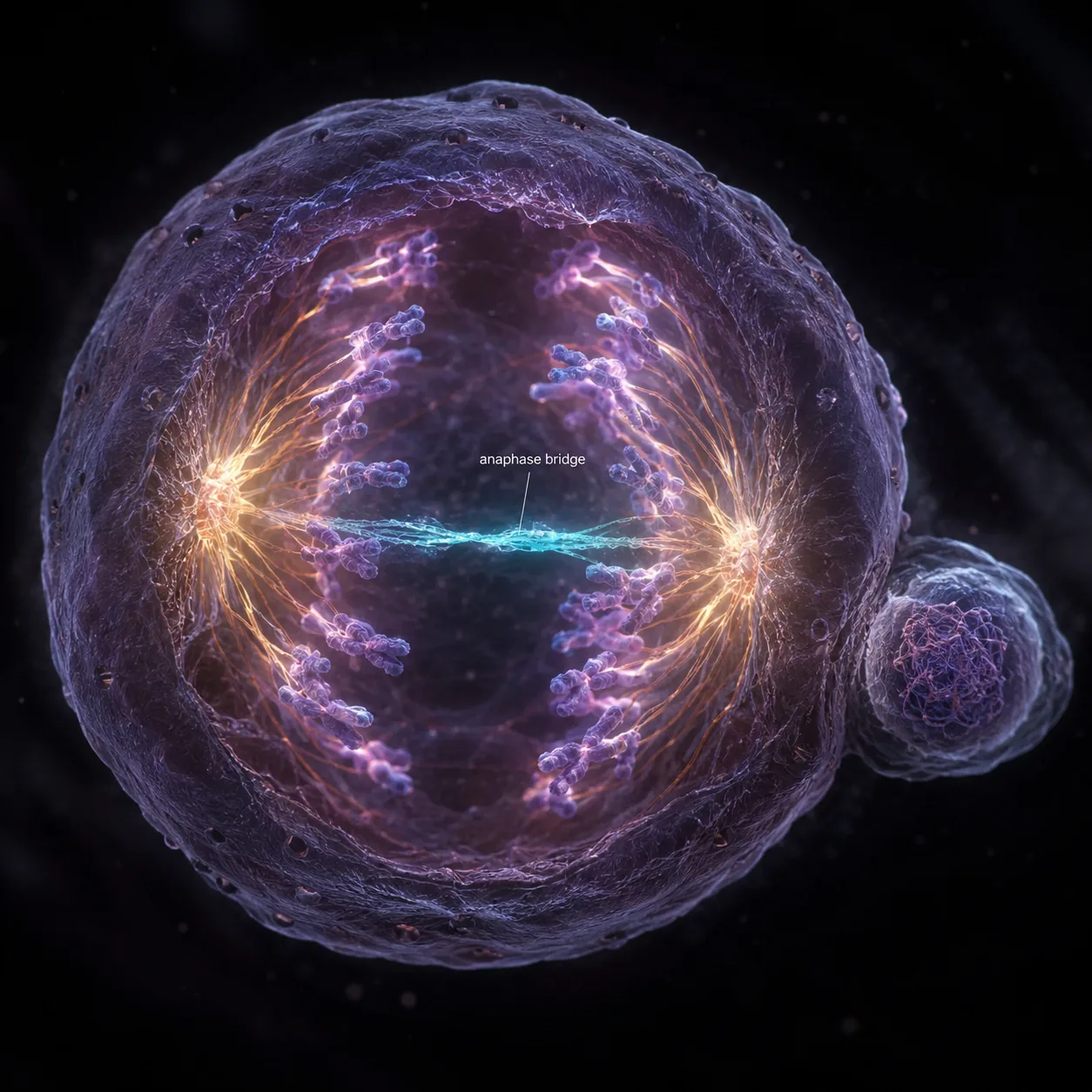
Beyond point mutations, many cancers exhibit chromosomal instability (CIN) — ongoing errors in chromosome segregation during mitosis that generate cells with abnormal chromosome numbers (aneuploidy) or structural rearrangements.
CIN is driven by:
- Defects in the spindle assembly checkpoint (MAD1, MAD2, BUB1/3) that normally halts mitosis when chromosomes aren't properly attached
- Centrosome amplification — extra centrosomes create multipolar spindles that mis-segregate chromosomes
- Cohesion defects that cause premature sister chromatid separation
- Replication stress generating DNA breaks that resolve as structural rearrangements
Most solid tumors are aneuploid. CIN generates rapid karyotypic diversity — a substrate for selection — and can simultaneously amplify regions containing oncogenes and delete regions containing tumor suppressors in a single mitotic error.
Summary(Summary)
Genome instability is an enabling characteristic rather than a direct functional capability — it doesn't make cancer cells grow or spread, but it dramatically accelerates acquisition of the mutations that do. Tumors achieve elevated mutation rates by disabling DNA repair pathways: MMR loss creates MSI-high hypermutation, BRCA1/2 loss creates HR deficiency exploitable by PARP inhibitors, and NER loss leaves tumors exquisitely sensitive to UV and chemical carcinogens. Mutational signatures — readable from a tumor's genome — reveal the processes that generated its mutations, with APOBEC, tobacco, UV, and MMR deficiency being the most prevalent. Chromosomal instability adds a parallel layer of genomic diversity through mitotic segregation errors. The clinical irony is that the most genomically unstable tumors are often the most immunologically visible — hypermutation generates neoantigens, which is why MSI-high status predicts checkpoint inhibitor response across cancer types.