Recall(What we covered)
Fourteen posts, one hallmark each. Sustaining proliferative signaling. Evading growth suppressors. Resisting cell death. Enabling replicative immortality. Inducing angiogenesis. Activating invasion and metastasis. Reprogramming metabolism. Avoiding immune destruction. Genome instability. Tumor-promoting inflammation. Phenotypic plasticity. Epigenetic reprogramming. Polymorphic microbiomes. Senescent cells. This post is the synthesis.
Three numbers define the arc of this framework: 6, 8, and 14.
Six hallmarks in 2000 — the minimum required to describe a cancer cell as biologically distinct from a normal one. Eight in 2011 — the framework expanded to include what the immune system and metabolism were telling the field. Fourteen in 2022 — the outer boundary of what a single paper could coherently define as "the cancer hallmarks" pushed outward again.
Each expansion was not a correction. The original six were not wrong. They were incomplete in the way any first framework is incomplete: true as far as it went, insufficient for what came next.
The recurring patterns
Reading all fourteen together, certain patterns emerge that no single post made fully visible.
Every hallmark has a developmental analog. Sustained proliferation echoes embryonic growth. EMT echoes gastrulation. Angiogenesis echoes vasculogenesis. Phenotypic plasticity echoes multipotency. The immune tolerance that tumors establish echoes maternal-fetal immune tolerance. Cancer doesn't invent new biology — it co-opts programs the body already built and normally keeps tightly regulated. This is why normal development and cancer biology have been in dialogue since the beginning of the field.
The same molecule appears in multiple hallmarks. TGF-β suppresses growth early (hallmark #2), induces EMT later (hallmark #6), drives CAF activation (hallmark #10), maintains immune tolerance (hallmark #8). HIF-1α drives angiogenesis (hallmark #5), shifts metabolism toward glycolysis (hallmark #7), promotes phenotypic plasticity (hallmark #11). NF-κB runs through inflammation (#10), immune evasion (#8), survival signaling (#3), and microbiome sensing (#13). The pathway map of cancer is not 14 independent circuits — it is one highly interconnected network that can be described from 14 angles.
Context inverts the biology. TGF-β is a tumor suppressor and a metastasis promoter. Senescent cells are tumor suppressors and tumor promoters. High immune infiltration predicts better outcomes with immunotherapy and worse outcomes in some inflammatory cancers. SASP clears pre-malignant cells and nurtures residual disease after chemotherapy. The rule in cancer biology is that the same molecule in the same cell can have opposite functions depending on developmental stage, microenvironmental context, and signaling state. This is not a problem with the biology — it is the biology. The hallmarks framework is most valuable when it captures this contextuality rather than flattening it.
The enabling characteristics deserve more credit
In the framework as presented, genome instability (#9) and tumor-promoting inflammation (#10) are labeled "enabling characteristics" rather than hallmarks proper. This risks understating them.
A tumor that acquires genome instability can rapidly evolve all other hallmarks. A tumor embedded in chronic inflammation already has angiogenic support, immune suppression, ECM remodeling, and survival signals provided by the microenvironment — it can acquire functional hallmarks far faster than a tumor in a normal tissue environment. The enabling characteristics don't just accelerate the process; in some cancers, they are the initiating event. H. pylori gastritis creating the inflammatory environment comes before the genetic hits. The mutator phenotype creating rapid genome evolution comes before the selection of specific driver mutations.
Intuition(Cancer is an evolutionary process, not a developmental one)
The hallmarks describe what a cancer cell looks like at the end, but they don't describe how it got there. The getting-there is Darwinian evolution under selection: cells with favorable traits (survival, proliferation) expand and accumulate further changes. Genome instability accelerates variation; the tumor microenvironment provides selective pressure; immune evasion determines which variants survive immune surveillance. The 14 hallmarks are convergent endpoints — the solutions that natural selection finds again and again across thousands of independent tumor lineages, in every tissue, in every person who gets cancer. That convergence is what makes the framework profound.
What 22 years of updates actually tell us
The 2022 additions (plasticity, epigenetics, microbiome, senescence) have a different character from the earlier hallmarks. The original 2000 hallmarks were mostly cell-intrinsic — properties of the cancer cell itself. The 2011 additions started incorporating the microenvironment (immune evasion, inflammation). The 2022 additions go further: they are about the cancer cell in ecological relationship with its environment.
Phenotypic plasticity is not a fixed property — it is a capacity for dynamic state transitions driven by environmental cues. Epigenetic reprogramming is not a mutation — it is a heritable change in how the environment of the genome is organized. Polymorphic microbiomes are literally ecological — the tumor is in a community with other organisms. Senescent cells are defined by their secretory relationship with the surrounding tissue.
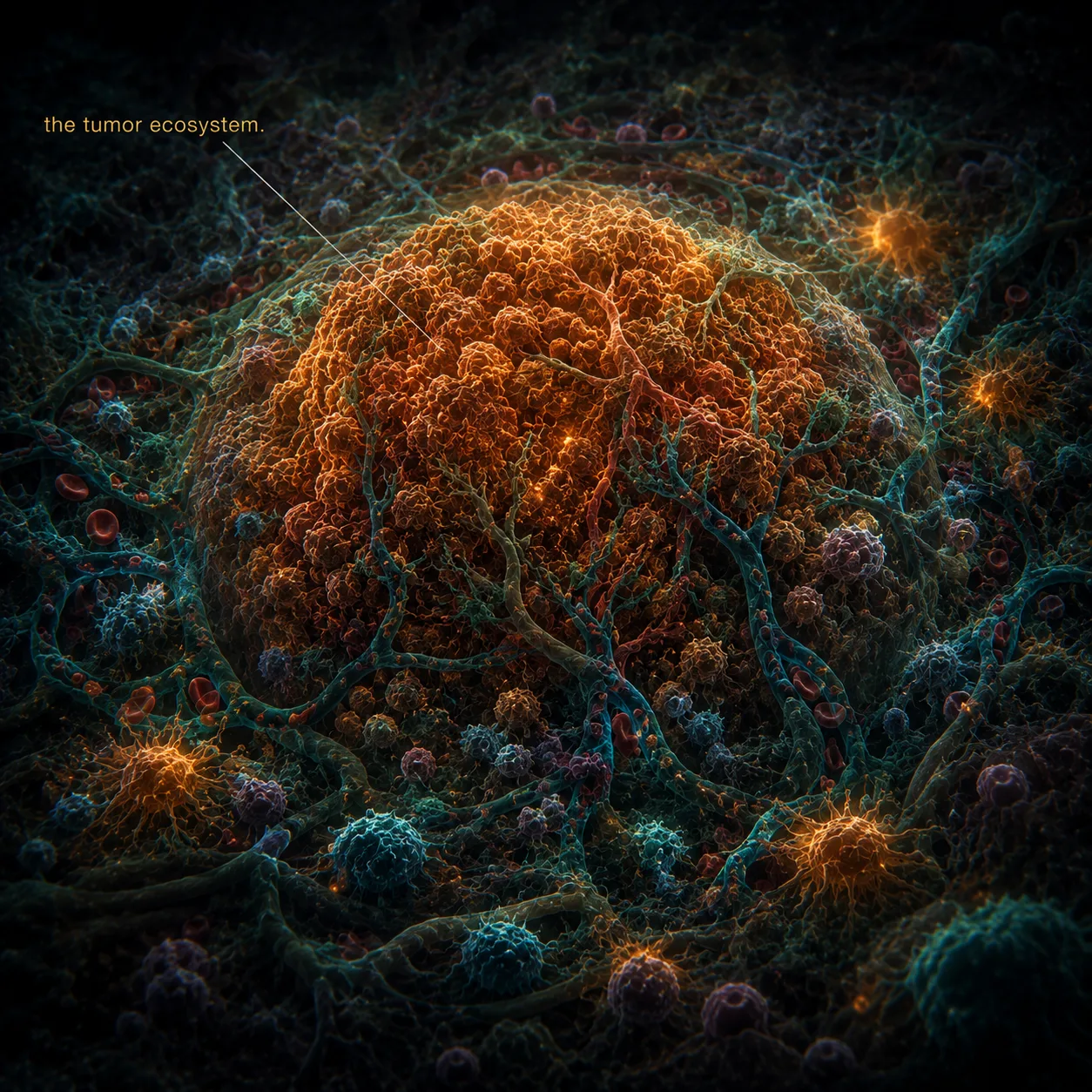
This is the field evolving toward a more systems-level view of cancer. The tumor is not a cell; it is an ecosystem. The 2022 hallmarks are a step toward a framework that reflects that.
Where the framework falls short
Warning(Limits of the checklist view)
The hallmarks framework is sometimes applied as a checklist — a tumor must acquire these 14 capabilities to be malignant. This misses something important: not every cancer acquires every hallmark. Hematologic malignancies may not need angiogenesis as critically as solid tumors. Leukemias don't need EMT in the conventional sense. Some pediatric cancers arise with very few driver mutations, relying on developmental mis-regulation rather than genomic chaos. The framework describes the general logic of cancer biology, not a universal specification. Use it as a conceptual map, not a passport checklist.
The framework also does not capture cancer as a disease of individual patients. The hallmarks are population-level generalizations — this is how cancer works, on average, across millions of cases. But no two cancers are the same, and no two patients are the same. A complete understanding of a specific patient's cancer requires moving from the general framework to the specific biology: which hallmarks, achieved through which mechanisms, in which order, shaped by which germline, microbiome, immune status, and treatment history. The hallmarks are the framework for asking the question. The answer is always particular.
The therapeutic logic
The therapeutic value of the hallmarks framework is in how it organizes drug development. Every approved cancer therapy is an attempt to block one or more hallmarks — and the framework predicts that blocking a single hallmark will be insufficient in most cases, because tumors have backup pathways and alternative routes to the same capability.
This is why combination therapies are the standard of care in most cancers: BRAF + MEK inhibitors in melanoma (blocking two nodes in the same pathway), PD-1 + CTLA-4 in melanoma (blocking two checkpoints), CDK4/6 + endocrine therapy in breast cancer (blocking proliferative signaling at two levels). And it's why resistance is almost universal to single-agent targeted therapy over long enough time: the hallmark doesn't disappear; the tumor finds another way to achieve it.
Example(The combination rationale across hallmarks)
The most durable responses in oncology come from combinations that cross hallmark boundaries. Immuno-oncology + targeted therapy works partly because the targeted therapy (BRAF inhibitor) reduces immune suppression while the immunotherapy (PD-1 inhibitor) activates T cells — hitting hallmarks #1 and #8 simultaneously. Chemotherapy + immune checkpoint inhibition works in part because chemotherapy-induced immunogenic cell death creates neoantigens that checkpoint inhibition allows T cells to act on — bridging hallmarks #9 and #8. The best combinations are not random — they follow the logic of the hallmarks.
A personal note on where this connects
Three hallmarks in this series connect directly to research I worked on, and they're not accidents of selection:
Hallmark #7 (metabolism) — HDAC inhibition affecting metabolic gene regulation. The mechanism sits at the intersection of epigenetics and metabolism, which is where most interesting cancer biology happens now.
Hallmark #8 (immune evasion) — Atf7ip, TSC1/TSC2, Nemvaleukin. Three different angles on the same problem: why immune cells in the tumor microenvironment fail to kill cancer cells, and what changes that. This hallmark is the one the field has been most excited about for the past decade, and for good reason — it's the one where therapeutic reversals have been most dramatic.
Hallmark #12 (epigenetic reprogramming) — KMT2D loss in T cell lymphoma. The enhancer landscape collapsing as a mechanism of transformation. A mutation in an epigenetic writer producing genome-wide consequences in gene expression without touching a single coding sequence. This is the hallmark that most changed how I think about what "driver" means in cancer.
The framework gave all three of those research questions a common language and a place in a larger picture. That's what a good framework does.
Summary(Closing)
The Hallmarks of Cancer framework is 25 years old and still the best available map of what cancer is. It has been expanded three times and will likely be expanded again — not because earlier versions were wrong, but because the biology keeps revealing new dimensions. The progression from 6 to 14 hallmarks tracks the field's maturation from a cell-intrinsic to an ecological view of malignancy. The framework's most important insight is also its simplest: cancer is a structured process, not random damage. It follows logic. Understanding the logic doesn't make it easier to treat — but it makes it possible to ask the right questions.