Recall(So far in this series)
A cancer cell that grows without signals (#1), ignores stop signals (#2), resists death (#3), and replicates indefinitely (#4) still has a practical problem: it needs oxygen and nutrients. Without a blood supply, a solid tumor hits a ceiling at roughly 1–2mm in diameter. Hallmark #5 is how it gets past that ceiling.
Every cell in your body sits within roughly 100 micrometers of a capillary. Beyond that distance, oxygen diffusion becomes limiting — cells start to suffocate. A tumor growing as a solid mass will outpace its existing blood supply long before it becomes clinically detectable. To keep growing, it needs new vessels.
The process of forming new blood vessels from existing ones is called angiogenesis. In healthy adults, it's tightly controlled — active during wound healing, the menstrual cycle, and exercise adaptation, but otherwise quiescent. Tumors learn to switch it on permanently.
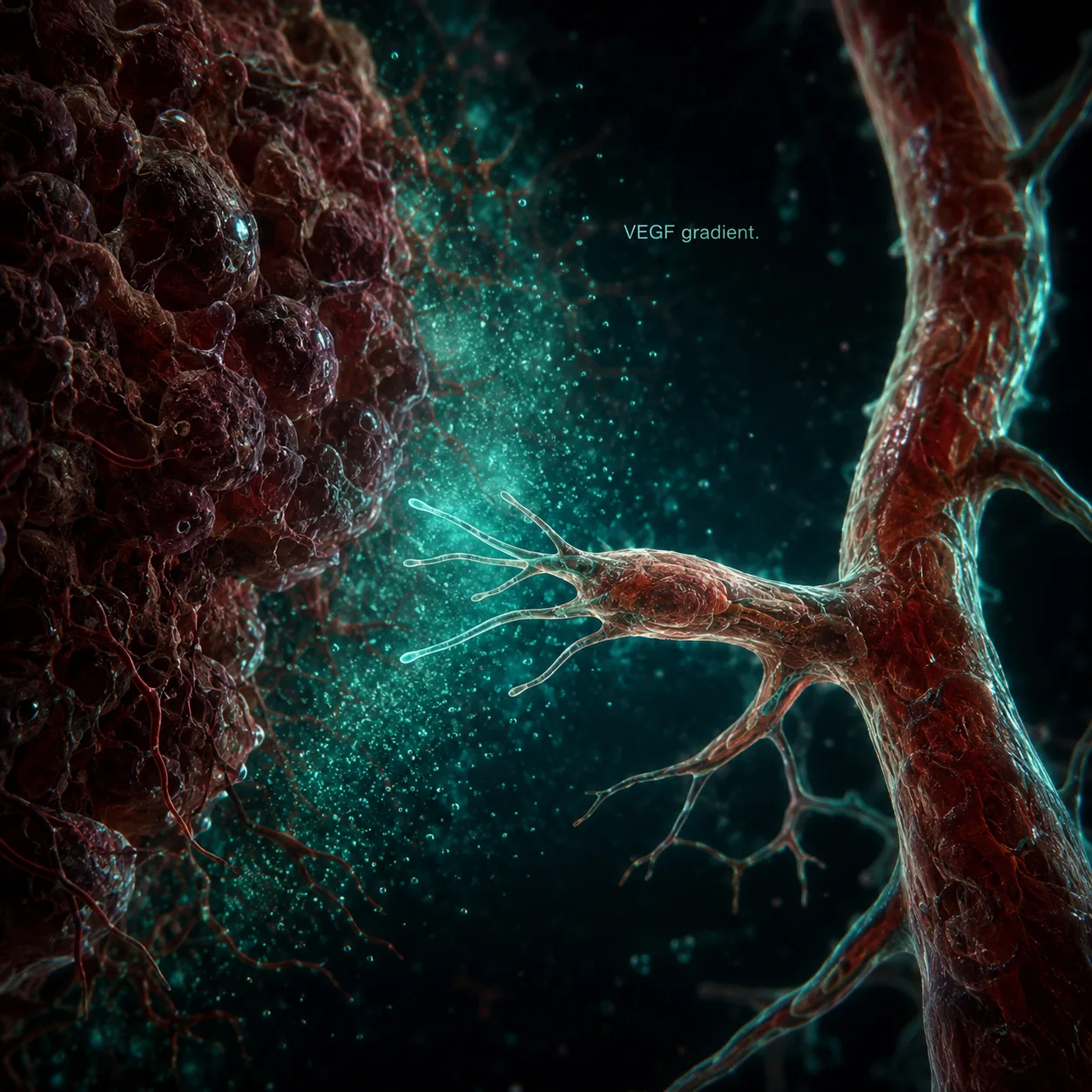
The angiogenic switch
In normal tissue, pro-angiogenic and anti-angiogenic signals are in balance, with the anti-angiogenic side dominant. The angiogenic switch is the moment when a tumor tips this balance — when pro-angiogenic factors overwhelm the inhibitors and new vessel formation begins.
Definition(Angiogenic switch)
The transition from a prevascular to a vascular tumor, characterized by a shift in the balance of pro- and anti-angiogenic regulators. Before the switch, tumor growth is limited by diffusion. After the switch, the tumor gains access to nutrients and oxygen, enabling rapid expansion and providing routes for metastasis.
This switch is not a single event tied to a single mutation. It can be triggered by hypoxia (the tumor outgrowing its existing supply), oncogene activation, loss of tumor suppressors, or signals from infiltrating immune cells. The trigger varies; the outcome is the same.
VEGF: the master regulator
The central player in tumor angiogenesis is VEGF (vascular endothelial growth factor) — specifically VEGF-A, which binds VEGFR2 on endothelial cells and drives their proliferation, migration, and tube formation.
Definition(VEGF (Vascular Endothelial Growth Factor))
A family of secreted glycoproteins (VEGF-A, B, C, D, and PlGF) that bind VEGF receptors (VEGFR1, 2, 3) on endothelial and lymphatic cells. VEGF-A/VEGFR2 signaling is the dominant driver of tumor angiogenesis. VEGF expression is strongly induced by hypoxia via HIF-1α.
The link between hypoxia and VEGF is direct and elegant. When oxygen levels drop, HIF-1α (hypoxia-inducible factor 1-alpha) is stabilized — normally it's rapidly degraded by VHL-mediated ubiquitination, but without oxygen the degradation machinery can't function. Stabilized HIF-1α translocates to the nucleus and transcriptionally activates VEGF, among many other hypoxia-response genes.
Tumors exploit this pathway in two ways:
- True hypoxia — the tumor center genuinely lacks oxygen, stabilizing HIF-1α naturally
- VHL loss — mutations in VHL (the E3 ubiquitin ligase that targets HIF-1α for degradation) constitutively stabilize HIF-1α even in normoxic conditions. This is the primary driver in clear cell renal cell carcinoma, where VHL mutation is nearly universal.
Example(Clear cell RCC and pseudo-hypoxia)
Clear cell renal cell carcinoma is essentially a disease of constitutive HIF-1α activation. VHL loss means HIF-1α is always active, VEGF is always being secreted, and the tumor is hypervascular — visibly full of aberrant blood vessels. This makes ccRCC highly sensitive to anti-VEGF therapy, which is why it was one of the first solid tumors where anti-angiogenics showed real benefit.
Other pro-angiogenic factors
VEGF is dominant but not alone. Tumors recruit new vessels through a broader secretome:
| Factor | Receptor | Role |
|---|---|---|
| VEGF-A | VEGFR2 | Endothelial proliferation, migration, permeability |
| VEGF-C/D | VEGFR3 | Lymphangiogenesis — lymphatic vessel formation |
| FGF-2 | FGFR1/2 | Synergizes with VEGF; promotes endothelial survival |
| PDGF-B | PDGFRβ | Pericyte recruitment — stabilizes new vessels |
| Angiopoietin-2 | TIE2 | Destabilizes existing vessels, priming them for remodeling |
| HGF | MET | Endothelial migration; also drives tumor invasiveness |
The coordination between these factors matters. VEGF drives endothelial proliferation, but new vessels need pericytes — supporting cells that wrap around capillaries and stabilize them. PDGF-B recruits pericytes. Angiopoietin-2 destabilizes existing vessels (making them leaky and easier to remodel) while angiopoietin-1 stabilizes new ones. A growing tumor is running a complex construction program, not just switching on a single signal.
What tumor vessels actually look like
This is where tumor angiogenesis gets clinically important: tumor vasculature is not normal vasculature. It is structurally chaotic — vessels are tortuous, irregularly branched, unevenly sized, poorly covered by pericytes, and leaky. Blood flow is erratic and often inefficient.
Intuition(Why leaky tumor vessels are a paradox)
Tumor vessels are leaky because VEGF increases vascular permeability — a feature that allows fluid and proteins to leak out of capillaries into tissue. In wound healing this is useful; it delivers clotting factors and nutrients. In a tumor, it creates high interstitial fluid pressure, which actually impedes drug delivery. Drugs that reach the tumor vasculature have to fight against this pressure gradient to penetrate into tumor tissue. Paradoxically, normalizing tumor vasculature (reducing leakiness) can improve drug delivery — this is the rationale behind "vascular normalization" strategies.
The chaotic architecture also means the tumor interior is still hypoxic even with a blood supply — flow is so irregular that oxygen delivery remains patchy. This sustained hypoxia drives continued HIF-1α activation and VEGF secretion, creating a self-reinforcing loop.
Anti-angiogenic therapy: the promise and the limits
Judah Folkman proposed in the 1970s that cutting off a tumor's blood supply could starve it into regression. It was a compelling idea and eventually produced real drugs — but the results have been more complicated than the original hypothesis suggested.
Bevacizumab (Avastin) — a monoclonal antibody against VEGF-A — was the first anti-angiogenic therapy approved (2004, colorectal cancer). It has since been approved for multiple cancer types. But across most indications, bevacizumab improves progression-free survival without consistently improving overall survival. The tumor tends to adapt.
Small molecule VEGFR inhibitors (sunitinib, sorafenib, pazopanib, axitinib, cabozantinib) target VEGFR kinase activity and have become standard of care in ccRCC, hepatocellular carcinoma, and thyroid cancer — settings where VEGF signaling is particularly dominant.
Warning(Why tumors escape anti-angiogenic therapy)
Resistance to anti-VEGF therapy follows a predictable pattern: the tumor switches to alternative pro-angiogenic pathways (FGF, angiopoietins, HGF) that the therapy doesn't block. It can also recruit bone-marrow-derived endothelial progenitor cells through VEGF-independent mechanisms, co-opt existing normal vasculature rather than building new vessels (vessel co-option, common in lung metastases), or become more invasive — spreading into well-vascularized normal tissue rather than building its own supply. Anti-VEGF therapy rarely eliminates angiogenesis; it tends to redirect it.
The current consensus is that anti-angiogenic therapy works best in combination — either with chemotherapy (where vascular normalization may transiently improve drug delivery) or with immunotherapy (where the immune-suppressive effects of VEGF on T cells make VEGF blockade complementary to checkpoint inhibition).
Summary(Summary)
Tumors can't grow beyond ~1–2mm without a blood supply. They induce angiogenesis by tipping the balance of pro- and anti-angiogenic signals — primarily through VEGF secretion driven by hypoxia and HIF-1α, but also through FGF, PDGF, angiopoietins, and other factors. The resulting vasculature is structurally abnormal — leaky, tortuous, and poorly perfused — which creates high interstitial pressure and impairs drug delivery. Anti-VEGF therapies have demonstrated real clinical benefit, particularly in ccRCC and colorectal cancer, but resistance through pathway switching is nearly universal. The most productive current use of anti-angiogenics is in combination with chemotherapy or immunotherapy rather than as monotherapy.