Recall(So far in this series)
Cancer cells grow without external signals (#1), ignore stop signals (#2), and resist death (#3). But there's still a hard limit built into every normal cell: it can only divide a finite number of times. Hallmark #4 is how cancer gets around that limit.
In 1961, Leonard Hayflick discovered something unexpected: normal human cells in culture don't divide indefinitely. They divide roughly 40–60 times, slow down, and enter a permanent non-dividing state. It didn't matter how well-nourished they were or how carefully they were maintained — there was a counter somewhere, and it ran out.
This limit is called the Hayflick limit. The counter is the telomere.
What telomeres are and why they shorten
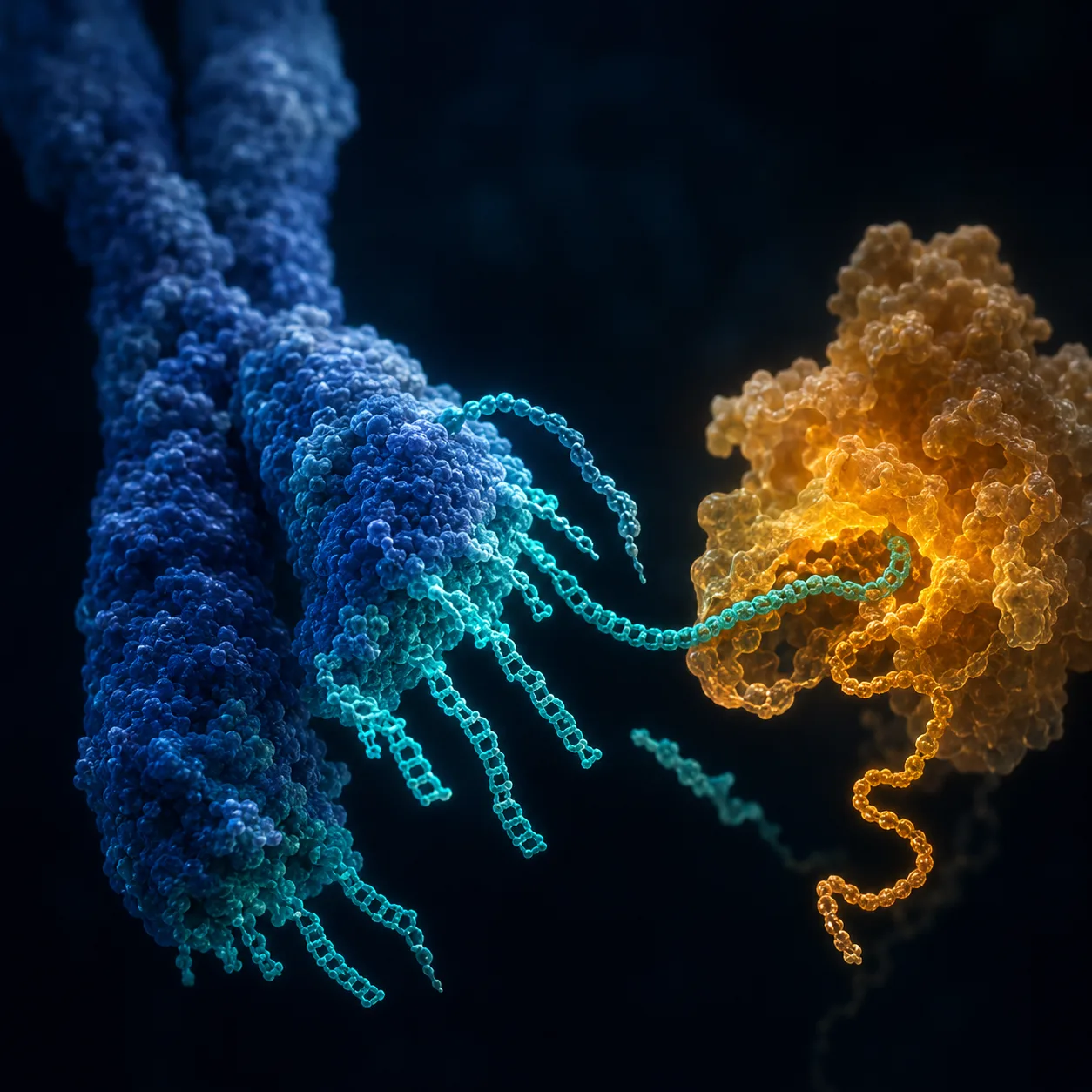
Telomeres are repetitive DNA sequences (TTAGGG in humans, repeated thousands of times) that cap the ends of chromosomes. They're not genes — they don't encode anything. Their job is structural: they protect chromosome ends from being recognized as double-strand breaks and being processed by DNA repair machinery.
The problem is that DNA replication is directionally incomplete. The enzyme that copies DNA (DNA polymerase) can only synthesize in one direction and requires a short RNA primer to get started. At the end of a chromosome, there's no room to place the final primer — so a small stretch of DNA at the very end goes uncopied with each round of replication.
The result: telomeres shorten by roughly 50–200 base pairs every time a cell divides.
Definition(Telomere)
Repetitive TTAGGG DNA sequences capping the ends of chromosomes, maintained by a specialized protein-RNA complex called shelterin. Telomeres protect chromosome ends from DNA damage responses and progressive shortening. In normal somatic cells, they shorten with each division until they reach a critical length that triggers senescence or apoptosis.
When telomeres get critically short, they lose their protective structure. The chromosome ends are now recognized as damaged DNA, which activates — p53 again — triggering either senescence (permanent arrest) or apoptosis. This is the Hayflick limit made molecular.
Two barriers cancer must get past
Senescence: the first wall
Before a cell reaches truly critical telomere length, it typically enters replicative senescence — a state of permanent, irreversible cell cycle arrest. The cell is alive and metabolically active, but it will not divide again.
Definition(Cellular senescence)
A state of stable, irreversible cell cycle arrest triggered by telomere shortening, DNA damage, oncogene activation, or other stresses. Senescent cells remain metabolically active and secrete a characteristic set of inflammatory cytokines, growth factors, and proteases collectively called the senescence-associated secretory phenotype (SASP). Senescence is a tumor-suppressive mechanism early in cancer development but can paradoxically promote tumor progression late-stage through SASP.
Senescence is the first barrier to immortalization. A pre-cancerous cell that has accumulated oncogenic mutations still has a built-in timer. If it can be pushed into senescence before acquiring additional mutations, it's neutralized.
Cancer has to get past this barrier.
Crisis: where the genome breaks
If a cell bypasses senescence — through p53 loss, RB inactivation, or other means — it keeps dividing past the Hayflick limit with progressively shorter telomeres. Eventually it reaches a state called crisis: telomeres become so short that chromosomes start fusing end-to-end.
Chromosome fusions are catastrophic. During cell division, fused chromosomes are pulled in opposite directions and break — generating new, random chromosome fusions, inversions, amplifications, and deletions. This is called breakage-fusion-bridge cycling, and it generates massive genomic instability.
Warning(Crisis is a mutation engine)
Counterintuitively, crisis — which kills most cells — is also the evolutionary crucible where many cancers acquire their most important mutations. The genomic chaos of crisis generates enormous diversity in a short time. Most cells in crisis die. But occasionally one survives by reactivating a mechanism to maintain its telomeres — and that cell has now passed through a bottleneck that selected for whatever mutations it happened to accumulate.
Two ways to solve the telomere problem
Telomerase: the 85% solution
The solution is an enzyme called telomerase — a reverse transcriptase that carries its own RNA template and uses it to add TTAGGG repeats back onto chromosome ends, replenishing what's lost during replication.
Telomerase is not expressed in most adult somatic cells. It is expressed in:
- Germline cells (sperm and eggs need unlimited replication potential)
- Stem cells (which need to self-renew across a lifetime)
- Certain immune cells (during activation)
In cancer, telomerase gets reactivated. In approximately 85–90% of human cancers, the TERT gene (which encodes the catalytic subunit of telomerase) is upregulated — often by mutations in the TERT promoter that create new transcription factor binding sites.
Definition(Telomerase)
A ribonucleoprotein enzyme that extends telomeres by adding TTAGGG repeats to chromosome ends. Composed of a catalytic reverse transcriptase subunit (TERT) and an RNA template component (TERC). Active in germline and stem cells; repressed in most somatic cells. Reactivated in ~85–90% of cancers.
Example(TERT promoter mutations)
Point mutations in the TERT promoter (C228T and C250T) are among the most common non-coding mutations in cancer — found in ~70% of melanomas, ~50% of bladder cancers, and frequent in glioblastoma, hepatocellular carcinoma, and thyroid cancer. These mutations create a new binding site for ETS transcription factors, driving TERT expression in cells that normally keep it silenced.
ALT: the recombination workaround
The minority of cancers that don't reactivate telomerase use a completely different mechanism: ALT (alternative lengthening of telomeres), which maintains telomeres through recombination-based DNA copying rather than enzymatic extension.
ALT is associated with loss of ATRX and DAXX — chromatin remodeling proteins that normally suppress recombination at telomeres. Without them, the cell's homologous recombination machinery can use one telomere as a template to copy sequence onto another, extending it without telomerase.
ALT is common in certain cancer types: osteosarcoma, glioma, and some soft tissue sarcomas. Tumors using ALT tend to have extremely heterogeneous telomere lengths — some very long, some very short — which distinguishes them from telomerase-positive tumors.
Intuition(Why ALT matters for therapy)
Telomerase inhibitors obviously don't work in ALT-positive tumors. And ALT tumors tend to have different mutation profiles (often ATRX/DAXX loss instead of TERT promoter mutations), different sensitivities to DNA-damaging agents, and in some cancer types, different prognoses. Distinguishing ALT from telomerase-positive tumors matters clinically — but ALT status isn't routinely tested in most oncology settings yet.
The therapeutic angle
Telomerase is an attractive drug target because it's active in cancer but not in most normal somatic tissue — the selectivity problem that plagues so many oncology targets is less severe here.
Telomerase inhibitors have been in development for decades. Imetelstat (a telomerase RNA template antagonist) is the furthest along — approved in 2024 for myelodysplastic syndromes and in trials for myelofibrosis and other hematologic cancers. The challenge is that telomerase inhibitors require many cell divisions to deplete telomeres to a critical length, meaning they work slowly and are more suited to settings where rapid response isn't essential.
GV1001 (a telomerase-derived peptide vaccine) and BIBR1532 (a small molecule TERT inhibitor) represent other approaches, though neither has reached approval.
Note
There's also the question of what happens to normal stem cells if telomerase is inhibited systemically. Bone marrow stem cells, gut epithelial stem cells, and skin stem cells all rely on telomerase. Short-term inhibition is probably tolerable; long-term systemic inhibition could cause tissue maintenance problems similar to the premature aging seen in congenital telomere disorders (dyskeratosis congenita, aplastic anemia).
Summary(Summary)
Normal cells carry a built-in division counter in their telomeres — shortening with each replication until a critical length triggers senescence or apoptosis. Cells that bypass senescence enter crisis, a state of catastrophic genomic instability that kills most cells but occasionally selects for one that reactivates telomerase (in ~85% of cancers) or switches to ALT (the remaining ~15%). Telomerase reactivation is largely driven by TERT promoter mutations, particularly C228T and C250T, which are among the most common non-coding mutations in human cancer. The therapeutic appeal of telomerase as a target is real — it's cancer-selective in a way few other targets are — but the slow mechanism of action and the dependency of normal stem cells on telomerase have complicated drug development.