Recall(A 2022 addition)
The 2022 Hallmarks update by Hanahan identified four emerging hallmarks reflecting insights that had accumulated since 2011. Phenotypic plasticity — the ability of cancer cells to reversibly switch between differentiation states — reflects a shift in thinking from viewing cancers as frozen at a particular developmental stage to understanding them as dynamic ensembles capable of continuous state transitions.
Cell identity is not a fixed property. During development, cells start as pluripotent progenitors and progressively commit to more specialized fates — becoming hepatocytes, neurons, epithelial cells — through layered epigenetic and transcriptional programs. Once committed, normal cells maintain their identity stably: a liver cell doesn't spontaneously become a lung cell. Differentiation is, in most contexts, a one-way street.
Cancer breaks this rule.
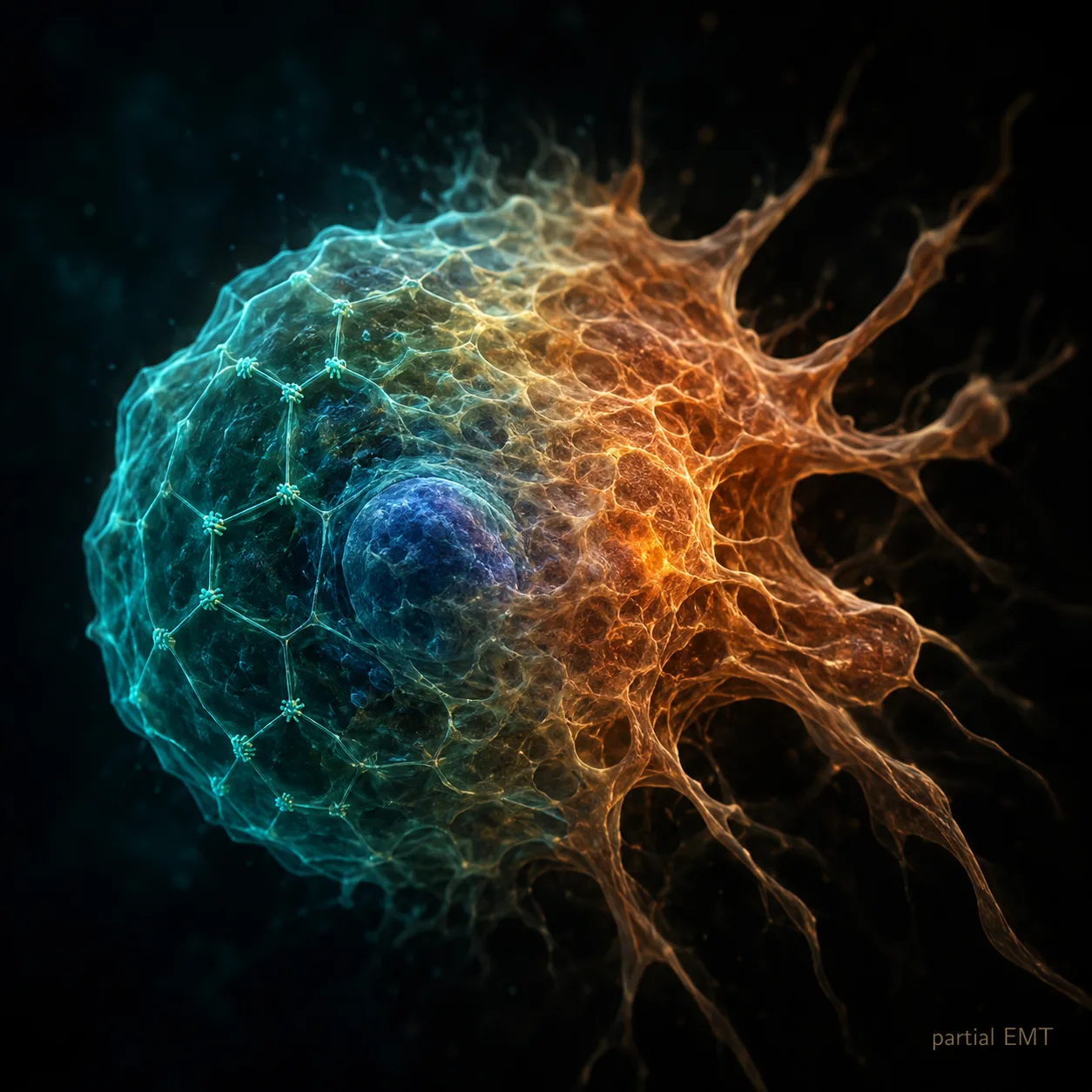
What phenotypic plasticity means in cancer
Phenotypic plasticity refers to the ability of cancer cells to transition between differentiation states — including movement between more differentiated and less differentiated (stem-like) states — without genetic change. These transitions are reversible and can be driven by signals from the tumor microenvironment.
This is distinct from the genetic evolution that underlies most hallmarks. Plasticity doesn't require a new mutation — it requires the re-activation (or maintenance of access to) developmental transcription factor programs that normal cells have locked away.
The clearest examples are found in two related phenomena: cancer stem cells and therapy-induced dedifferentiation.
Definition(Cancer stem cells (CSCs))
A subset of cells within a tumor that possess stem cell properties — self-renewal capacity, the ability to regenerate the full heterogeneity of the tumor, and resistance to therapy. Also called tumor-initiating cells. The defining functional assay is serial transplantation: a CSC should be able to initiate a new tumor when transplanted into an immunodeficient host, while non-CSC populations from the same tumor cannot.
The cancer stem cell hypothesis was controversial for years because it implied tumor hierarchy — only certain cells could regenerate the tumor, the rest were dead ends. Evidence from breast, colon, brain, and other cancers supported this model. But single-cell transcriptomics revealed something more complex: CSC and non-CSC populations are not fixed compartments; they interconvert. Non-CSC cells can revert to a CSC-like state in response to microenvironmental signals (hypoxia, inflammation, Wnt, Notch, Hedgehog signaling). The hierarchy is real but fluid.
Developmental programs cancer hijacks
Several master transcription factor programs control cell fate, and cancer re-activates them:
WNT/β-catenin maintains intestinal stem cells and is co-opted in colorectal cancer (where APC mutations constitutively activate it) and many other cancers to maintain stem-like states.
NOTCH regulates cell fate decisions in numerous tissues. In many cancers (T-ALL, triple-negative breast cancer, pancreatic cancer) it is re-activated and drives undifferentiated, proliferative states.
Hedgehog signaling is required for developmental patterning and is normally silenced in adult tissue. Aberrant Hedgehog activation (through PTCH1 loss or SMO mutation) drives basal cell carcinoma and medulloblastoma, and maintains CSC populations in many other tumor types.
SOX2, OCT4, NANOG, KLF4 — the Yamanaka reprogramming factors — are transcription factors that define pluripotency in embryonic stem cells and are sufficient, in combination, to reprogram differentiated cells back to pluripotent states. Their expression is reactivated in many cancers, maintaining tumor cells in a stem-like, undifferentiated state.
Example(Therapy-induced dedifferentiation: how treatment creates resistance)
A striking form of phenotypic plasticity is therapy-induced lineage switching. Prostate cancer treated with androgen receptor (AR) pathway inhibitors (enzalutamide, abiraterone) can undergo lineage switching to a neuroendocrine phenotype — expressing neural markers, losing AR expression, and becoming completely insensitive to AR-targeting drugs. This transition is not driven by new mutations in most cases; it is an epigenetic reprogramming event driven by selection pressure. Similarly, EGFR-mutant lung cancers can switch to small cell phenotypes under osimertinib pressure. The tumor is not evolving genetically — it is reshaping its identity to escape the therapy's mechanism.
EMT as phenotypic plasticity
The epithelial-mesenchymal transition discussed in hallmark #6 (invasion and metastasis) is itself a form of phenotypic plasticity. Cells shift between epithelial and mesenchymal states reversibly, with the intermediate hybrid E/M state being particularly stable and associated with stemness, therapy resistance, and metastatic capacity.
EMT is driven by the same developmental transcription factors (SNAIL, TWIST, ZEB1/2) that cancer co-opts from embryonic development, where EMT is essential for forming the body plan. This is a recurring pattern: hallmarks of cancer are often hallmarks of development, re-activated out of context.
Implications for therapy resistance
Phenotypic plasticity creates therapy resistance problems that genetic models don't fully explain. If a drug kills 99.9% of tumor cells but a small CSC population survives — and that CSC population can regenerate the full tumor — then the drug has not achieved durable control. If environmental stress can push non-CSC cells back into a CSC state, the problem compounds.
This is why:
- Tumors that initially respond to therapy often relapse with more aggressive, undifferentiated disease
- Targeting surface markers on CSC populations (many clinical trials) has been difficult — markers shift as cells transition states
- Combination strategies that target both the bulk tumor and the CSC compartment are theoretically necessary but practically complex
Intuition(Why you can't kill your way to a cure in some tumors)
In a purely genetic model of cancer evolution, therapy works by killing sensitive cells and hopefully clearing the tumor before resistant mutations emerge. In a plasticity model, the problem is different: even perfectly sensitive cells can escape by transitioning states. This suggests that targeting the signals that maintain plasticity — the WNT/NOTCH/Hedgehog pathways, the epigenetic regulators of cell identity — may be as important as targeting proliferative drivers. Differentiating agents (all-trans retinoic acid in APL, IDH inhibitors in AML) work precisely by re-engaging the differentiation programs that keep cells from transitioning back to stem-like states.
Summary(Summary)
Phenotypic plasticity — the ability of cancer cells to reversibly transition between differentiation states — was formalized as a hallmark in 2022, reflecting evidence that tumors are not hierarchically frozen but dynamically shifting populations. Cancer achieves this by re-engaging developmental transcription factor programs (WNT, NOTCH, Hedgehog, SOX2/OCT4) that normal adult cells keep silenced. The clearest manifestations are cancer stem cells (CSC/non-CSC interconversion driven by microenvironmental signals), therapy-induced lineage switching (prostate cancer → neuroendocrine phenotype, EGFR-mutant NSCLC → small cell), and the hybrid EMT state associated with stemness and metastatic capacity. Plasticity creates therapy resistance that is qualitatively different from mutation-based resistance — it requires strategies that target the signaling and epigenetic machinery that permits state switching, not just the proliferating bulk.