Recall(A hallmark with two faces)
Senescent cells appeared earlier in this series as a tumor suppression mechanism — in hallmark #4 (replicative immortality), oncogene-induced senescence was presented as a barrier that pre-cancerous cells must overcome. Here, in the final hallmark, the picture reverses: accumulated senescent cells in the tumor microenvironment actively promote cancer progression. Both are correct. The context — timing, location, cellular composition — determines which effect dominates.
In hallmark #4, we encountered cellular senescence as a response to replicative stress: cells that have divided too many times, or that have received aberrant oncogenic signals, arrest permanently and enter a state called replicative or oncogene-induced senescence. This arrest is tumor-suppressive — it removes pre-cancerous cells from the cycling pool.
But senescent cells are not inert. They remain metabolically active and secrete a complex cocktail of cytokines, chemokines, growth factors, and proteases known as the senescence-associated secretory phenotype (SASP). And as senescent cells accumulate — in aged tissue, in chronically inflamed tissue, and in tumors treated with chemotherapy or radiation — their secretory activity fundamentally reshapes the surrounding tissue.
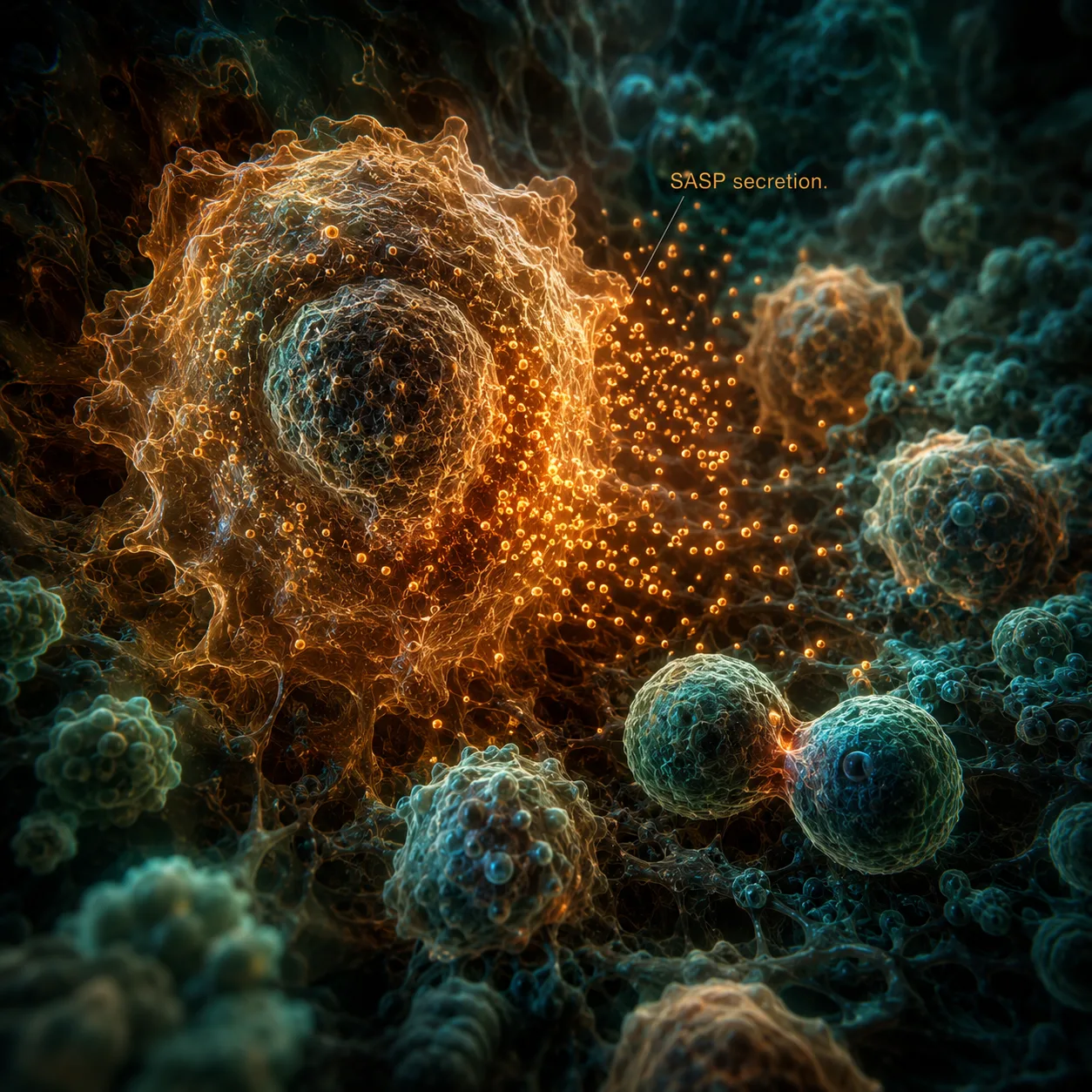
What SASP contains and what it does
Definition(Senescence-associated secretory phenotype (SASP))
The secretory profile of a senescent cell: a mixture of pro-inflammatory cytokines (IL-1α, IL-1β, IL-6, IL-8), chemokines (CXCL1, CXCL2, CCL2, CCL20), growth factors (HGF, VEGF, EGF, IGF1), matrix metalloproteinases (MMP1, MMP3, MMP10), and other regulators. The composition is context-dependent — cell type, tissue, and the trigger of senescence all influence which SASP components dominate. NF-κB and C/EBPβ are the primary transcriptional drivers of SASP.
The SASP was originally understood as a mechanism of immune surveillance: the inflammatory secretion of a senescent cell recruits NK cells and macrophages to eliminate it (a process called senescent cell clearance). In this context, SASP is tumor-suppressive — it flags damaged cells for immune elimination.
In an established tumor or in aged tissue where immune clearance is impaired, the same SASP acts pro-tumorigenic:
- IL-6 and IL-8 activate JAK/STAT3 and NF-κB in neighboring cancer cells, promoting survival, proliferation, and stem-like states
- VEGF promotes angiogenesis (hallmark #5)
- MMPs remodel the ECM to facilitate invasion (hallmark #6)
- HGF, EGF stimulate tumor cell proliferation (hallmark #1)
- CCL2 recruits monocytes and promotes M2 macrophage polarization (hallmark #10)
- IL-1α/β drives chronic inflammation (hallmark #10)
The SASP can also induce senescence in neighboring cells (paracrine senescence), spreading the secretory phenotype through the tissue.
The same mechanism, two outcomes
When an oncogene is first activated in a normal cell — a gain-of-function RAS mutation, for instance — it drives hyperproliferative signaling that initially triggers a DNA damage response and p53/p16 activation. The cell enters oncogene-induced senescence (OIS), a stable arrest that prevents malignant transformation.
This is well-established cancer biology. OIS explains why benign nevi (moles) harbor BRAF V600E mutations — a normally potent oncogenic driver — but don't progress to melanoma for years or decades. The BRAF-mutant melanocytes have entered OIS and are stably arrested.
Escape from OIS requires inactivating the arrest mechanisms: losing p53, p16/CDKN2A, or the upstream DDR signaling. This is why p16 and p53 loss are so common in cancer — they are the barriers to OIS escape.
Intuition(The pre-cancer window)
The period of OIS is actually a window of therapeutic opportunity. The senescent cells are non-proliferating but visible to the immune system, and an intact immune response clears them before they escape. Aging and immune suppression reduce this clearance efficiency. This helps explain why cancer incidence rises steeply with age — not just because mutations accumulate, but because the immune system's ability to clear OIS cells declines, and the SASP from uncleared senescent cells remodels the tissue toward a pro-tumorigenic state.
When treatment creates more zombie cells
Beyond OIS, a major driver of tumor-associated senescent cells is treatment itself. Chemotherapy, radiation, and some targeted therapies induce senescence in cancer cells that survive sub-lethal doses. These therapy-induced senescent (TIS) cells are growth-arrested but not dead — and they secrete a SASP.
TIS and SASP have been proposed as mechanisms of:
- Early therapy response: senescent cells initially reduce tumor burden without requiring apoptosis
- Inflammation-driven relapse: SASP from TIS cells recruits pro-tumorigenic immune cells, promotes EMT in surviving cancer cells, and creates a growth-permissive microenvironment for residual disease
- Drug resistance acquisition: SASP factors (particularly HGF activating MET, and IL-6 activating STAT3) provide paracrine survival signals to non-senescent neighboring cancer cells, increasing their resistance to the same treatment
This is the "treatment-induced progression" paradox: therapy creates senescent cells that, through SASP, provide a survival advantage to the cells that weren't killed.
Example(Chemotherapy, SASP, and WNT16B)
A striking demonstration: Sun et al. (2012) showed that prostate cancer cells treated with genotoxic chemotherapy induced WNT16B expression in neighboring stromal fibroblasts via NF-κB. WNT16B was secreted into the tumor microenvironment and protected cancer cells from apoptosis — the chemotherapy was directly generating the signal that protected the remaining tumor cells. The same principle applies more broadly: genotoxic therapy creates a senescent stromal SASP that partially counteracts its own cytotoxic effect.
Senolytics and senomorphics: targeting senescent cells
The recognition that senescent cells contribute to cancer progression has driven development of two therapeutic approaches:
Senolytics selectively eliminate senescent cells. The prototype combination is dasatinib + quercetin (D+Q), now in multiple clinical trials. Navitoclax (BCL-2/BCL-XL/BCL-W inhibitor) exploits the anti-apoptotic gene upregulation that keeps senescent cells alive. The clinical hypothesis: clearing therapy-induced senescent cells during or after treatment would prevent SASP-driven relapse.
Senomorphics inhibit SASP production without eliminating senescent cells — the approach in contexts where the senescent cell's anti-proliferative function should be preserved but its secretory activity dampened. Rapamycin, JAK1/2 inhibitors (ruxolitinib), and NF-κB inhibitors have senomorphic activity.
Warning(The timing problem)
The cancer context determines whether removing senescent cells helps or harms. In early carcinogenesis, OIS cells are tumor-suppressive; clearing them before they escape (or before the immune system does it naturally) removes a barrier. In established tumors with SASP-driven progression, removing TIS cells after treatment might reduce the pro-tumorigenic microenvironment but could also remove cells that were growth-arrested and contributing to tumor control. Clinical trials with senolytics in cancer are in early stages; the optimal timing relative to primary therapy is not established.
Senescence and immunotherapy
Senescent cells in the TME create a dual relationship with immunotherapy. On the negative side, SASP-driven recruitment of MDSCs, Tregs, and M2 macrophages creates an immunosuppressive environment that limits checkpoint inhibitor efficacy. On the positive side, senescent cancer cells (induced by OIS or TIS) upregulate immune activating ligands (NKG2D ligands, MHC I) and are visible targets for NK cells and T cells. Combining senescence inducers with checkpoint inhibitors is an active research strategy — induce senescence in residual tumor cells to make them immunologically visible, then use checkpoint inhibition to boost the immune response against them.
Summary(Summary)
Senescent cells are the final hallmark because they are the most contextual. The same biological state — permanent cell cycle arrest with active SASP secretion — is tumor-suppressive early (OIS clearing pre-cancerous cells), immune-activating in clearance contexts (SASP recruiting NK cells and macrophages to eliminate senescent cells), and tumor-promoting late (TIS and stromal senescence driving SASP-mediated immune suppression, EMT, angiogenesis, and paracrine survival of residual cancer cells). The clinical application is senolytics and senomorphics — drugs that either eliminate senescent cells or blunt their SASP — with the timing and tumor context being the critical variables. This completes the 2022 hallmarks update: phenotypic plasticity, epigenetic reprogramming, polymorphic microbiomes, and senescent cells each represent a dimension of cancer biology that the original 2000 and 2011 frameworks left underspecified.