Recall(This is the hallmark where the research connects)
Posts in this series have noted where specific research connects to specific hallmarks. Hallmark #12 is the one I worked on most directly — KMT2D loss in T cell lymphoma is epigenetic reprogramming made concrete. The mechanism below is not abstract: it is what happens when a histone methyltransferase is lost in a cancer cell.
The genetic model of cancer — mutations accumulate, driver genes are hit, the cell transforms — is correct but incomplete. For decades, oncologists and researchers noticed that gene expression patterns in cancer diverged from normal tissue far more than could be explained by DNA sequence changes alone. The tumor suppressor genes that were silenced often had no mutation in their coding sequence. The oncogenes that were activated often had no amplification.
The explanation was epigenetic. The DNA sequence was intact, but the annotations on top of it — DNA methylation, histone modifications, chromatin architecture — had been fundamentally altered.
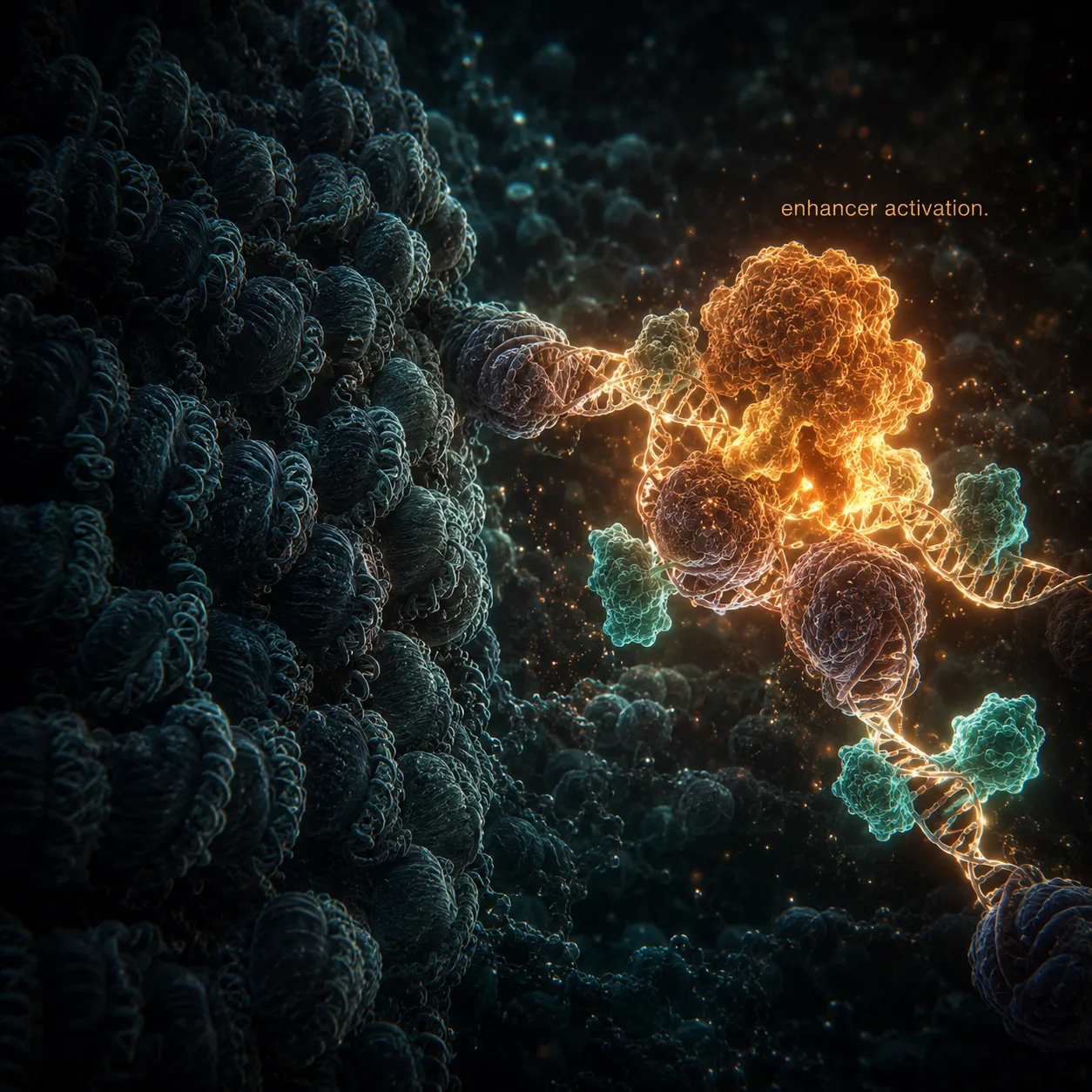
What epigenetics is and why it matters
Definition(Epigenetics)
Heritable changes in gene expression that do not involve alterations to the DNA sequence. The primary mechanisms are DNA methylation (addition of methyl groups to cytosine, typically at CpG dinucleotides), histone modification (acetylation, methylation, phosphorylation, ubiquitination at histone tails), and ATP-dependent chromatin remodeling (repositioning of nucleosomes to expose or occlude DNA). Together these mechanisms constitute the epigenome — a cell-type-specific pattern of regulatory states that determines which genes are accessible and expressed.
The key properties of epigenetic states that make them relevant to cancer:
- Heritability through cell division — epigenetic marks are copied during DNA replication, so a reprogrammed epigenome is inherited by all daughter cells
- Reversibility — unlike mutations, epigenetic changes can in principle be reversed by pharmacological intervention
- Context-specificity — the same DNA sequence has different epigenetic states in different cell types, which is how cells maintain their identity
- Crosstalk with metabolism — epigenetic enzymes use metabolic cofactors (SAM, acetyl-CoA, αKG, NAD⁺) as substrates, directly linking hallmark #7 (metabolism) to gene regulation
DNA methylation changes in cancer
The CpG methylation landscape of cancer genomes is globally altered in two opposing directions simultaneously:
Global hypomethylation: repetitive elements, transposable elements, and gene bodies that are normally methylated lose methylation in cancer. This leads to genomic instability (demethylated repetitive elements can re-activate), inappropriate gene expression, and loss of imprinting.
Focal hypermethylation: specific promoter CpG islands that are normally unmethylated become heavily methylated and silenced in cancer. This is one of the primary mechanisms of tumor suppressor gene silencing — MLH1 (mismatch repair), CDH1 (E-cadherin), CDKN2A (p16/p14ARF), BRCA1, and many others are epigenetically silenced in specific cancer types through promoter hypermethylation rather than mutation.
Intuition(Two-hit hypothesis, epigenetic edition)
Knudson's two-hit hypothesis posits that both copies of a tumor suppressor must be inactivated for loss of function. The hits don't have to be mutational. In colorectal cancer, MLH1 silencing by promoter methylation accounts for the majority of sporadic MSI-high cases — both alleles methylated, no mutation required. In breast cancer, BRCA1 promoter methylation creates HR-deficient tumors functionally equivalent to germline BRCA1 mutants, but they arise de novo in the soma rather than being inherited.
Histone modification: writing and erasing the marks
Histones — the proteins around which DNA is wrapped — carry an extensive set of post-translational modifications at their N-terminal tails that regulate chromatin accessibility and gene expression:
| Mark | Writers | Erasers | Association |
|---|---|---|---|
| H3K27ac | CBP/EP300 | HDAC complexes | Active enhancers, transcription |
| H3K4me3 | KMT2 family (MLL1-4) | KDM5 family | Active promoters |
| H3K27me3 | PRC2 (EZH2) | KDM6A/6B | Polycomb repression |
| H3K9me3 | G9a, SUV39H1 | KDM3/4 | Constitutive heterochromatin |
| H3K36me3 | SETD2 | KDM2B | Transcribed gene bodies |
The balance between these marks — particularly the opposition between active H3K4me3 at promoters and repressive H3K27me3 — determines whether a gene is expressed. Cancer disrupts this balance by mutating the enzymes that write, erase, or read these marks.
Definition(KMT2D (MLL4) in cancer)
KMT2D (lysine methyltransferase 2D, also called MLL4) is a histone H3K4 methyltransferase — one of the primary writers of H3K4me1 at enhancers. Loss-of-function mutations in KMT2D are among the most frequent epigenetic alterations in cancer: found in ~30% of B cell lymphomas, ~20% of gastric and colorectal cancers, and recurrently in bladder, breast, and lung cancers. When KMT2D is lost, active enhancer marks are not written, enhancer-driven gene expression is disrupted, and — in lymphoma specifically — the normal transcriptional programs that maintain B cell differentiation collapse. Tumor suppressor gene networks downstream of KMT2D-dependent enhancers are silenced, and cells adopt a more proliferative, undifferentiated state without a single additional mutation.
The chromatin machinery cancer hijacks
Polycomb repression and EZH2
The PRC2 complex (Polycomb Repressive Complex 2), of which EZH2 is the catalytic subunit, writes H3K27me3 — a repressive mark that silences developmental genes in a lineage-appropriate manner. EZH2 is:
- Gain-of-function mutated (Y641, A677) in follicular lymphoma and DLBCL, causing pathologically elevated H3K27me3 and widespread silencing of genes that would normally be expressed in mature B cells
- Overexpressed (without mutation) in prostate, breast, bladder, and many other solid tumors through MYC-driven transcription
- Deleted in T-ALL, myeloid malignancies, and some solid tumors, where loss of repression drives different transcriptional programs
This bidirectionality is a pattern in epigenetic cancer drivers: the same enzyme can be oncogenic in one context (gain-of-function in B cell lymphoma) and tumor suppressive in another (loss of function in T cell malignancies). Context matters because the epigenome is a coordinate system, not a list.
Example(EZH2 inhibitors: tazemetostat)
Tazemetostat, an EZH2 inhibitor, was approved in 2020 for EZH2-mutant follicular lymphoma and epithelioid sarcoma (which lacks the SWI/SNF component SMARCB1, creating dependence on PRC2 activity). It blocks the catalytic activity of EZH2, reducing H3K27me3 and re-engaging silenced gene programs. Response rates in EZH2-mutant follicular lymphoma are ~69%. The drug illustrates the therapeutic logic of reversibility: unlike mutations, epigenetic states can potentially be pharmacologically reset.
SWI/SNF: the remodeler that gets deleted
The SWI/SNF complex (also called BAF in mammals) is an ATP-dependent chromatin remodeler — it repositions nucleosomes to physically open or close chromatin at regulatory regions. Components of the SWI/SNF complex are mutated in ~20% of all human cancers, making it one of the most commonly altered epigenetic regulators in the genome.
Key SWI/SNF subunits mutated in cancer:
- SMARCA4 (BRG1) — ATPase catalytic subunit; lost in ovarian small cell carcinoma hypercalcemic type, lung cancer, others
- SMARCB1 (SNF5/INI1) — lost in malignant rhabdoid tumors (pediatric), epithelioid sarcoma
- ARID1A — most frequently mutated BAF subunit; lost in ovarian clear cell carcinoma (~50%), endometrial cancer, gastric cancer
When SWI/SNF is lost, PRC2 gains access to regions it would normally be evicted from — SMARCB1-deficient tumors are particularly dependent on PRC2 activity, which is why they respond to EZH2 inhibition. This antagonism between SWI/SNF and PRC2 is a fundamental axis of chromatin regulation in cancer.
Translating this into treatment
Histone deacetylases (HDACs) remove acetyl groups from histone tails, compacting chromatin and suppressing transcription. HDAC inhibitors (vorinostat, romidepsin, belinostat, panobinostat) are approved for various hematologic malignancies — T cell lymphomas and multiple myeloma.
Their mechanism is less clean than targeted therapy: HDACs have hundreds of substrates including non-histone proteins (p53, HSP90, tubulin), so HDAC inhibitors are pleiotropic. This creates efficacy in some contexts (T cell lymphoma, where specific HDAC dependencies have been identified) and toxicity challenges in others.
The more precise tool is targeted inhibition of individual chromatin regulators — EZH2, DOT1L, BET bromodomains, LSD1 — approaches that are in various stages of clinical development.
Summary(Summary)
Nonmutational epigenetic reprogramming acknowledges that cancer rewrites the regulatory annotations on the genome — not just the sequence. The primary mechanisms are promoter CpG hypermethylation (silencing tumor suppressors like MLH1, CDH1, BRCA1 without mutation), loss-of-function mutations in histone methyltransferases (KMT2D in lymphoma — silencing enhancer-driven gene programs), gain-of-function EZH2 mutations spreading H3K27me3 repression, and SWI/SNF loss enabling Polycomb dominance over chromatin accessibility. These alterations are heritable through cell division but pharmacologically reversible — the basis for EZH2 inhibitors (tazemetostat), HDAC inhibitors, and the broader epigenetic therapy field. The KMT2D story in T cell lymphoma sits at the center of this hallmark: enhancer landscape collapse as a mechanism of transformation, without a single new coding mutation required.