Recall(An enabling characteristic)
Like genome instability, tumor-promoting inflammation is an enabling characteristic — it accelerates and amplifies the other hallmarks rather than being a functional capability in itself. What makes it striking is the reversal: inflammation evolved to protect against pathogens and damaged tissue, but tumors turn it into a tool for their own benefit.
Rudolf Virchow noticed in 1863 that tumors often arose at sites of chronic inflammation, and that inflammatory cells were a consistent feature of tumor tissue. For most of the following century, this was interpreted as the immune system trying — and failing — to destroy the tumor. The modern understanding is more disturbing: much of the inflammation within tumors is actively helping them.
Inflammation as a cancer risk factor
The epidemiological connection between chronic inflammation and cancer risk is strong and consistent:
- Chronic hepatitis B and C infection → hepatocellular carcinoma
- H. pylori infection (causing chronic gastritis) → gastric cancer and MALT lymphoma
- Inflammatory bowel disease (Crohn's disease, ulcerative colitis) → colorectal cancer
- Barrett's esophagus (chronic acid reflux-driven inflammation) → esophageal adenocarcinoma
- Chronic pancreatitis → pancreatic cancer
- Asbestos-induced pulmonary inflammation → mesothelioma
In each case, the cancer doesn't arise from the pathogen or irritant directly damaging DNA — it arises from the sustained inflammatory response the body mounts in response to it. Reactive oxygen and nitrogen species generated by inflammatory cells cause DNA damage; inflammatory cytokines drive proliferation; growth factors secreted by immune cells support cell survival.
Definition(Tumor microenvironment (TME))
The non-malignant cellular and acellular components surrounding tumor cells within a solid tumor: cancer-associated fibroblasts (CAFs), endothelial cells, pericytes, and infiltrating immune cells (macrophages, neutrophils, T cells, B cells, NK cells, MDSCs), embedded in an extracellular matrix and bathed in a milieu of cytokines, growth factors, and metabolites. The TME is not passive scaffolding — it actively participates in tumor progression, immune evasion, angiogenesis, invasion, and therapy resistance.
The cells that switch sides
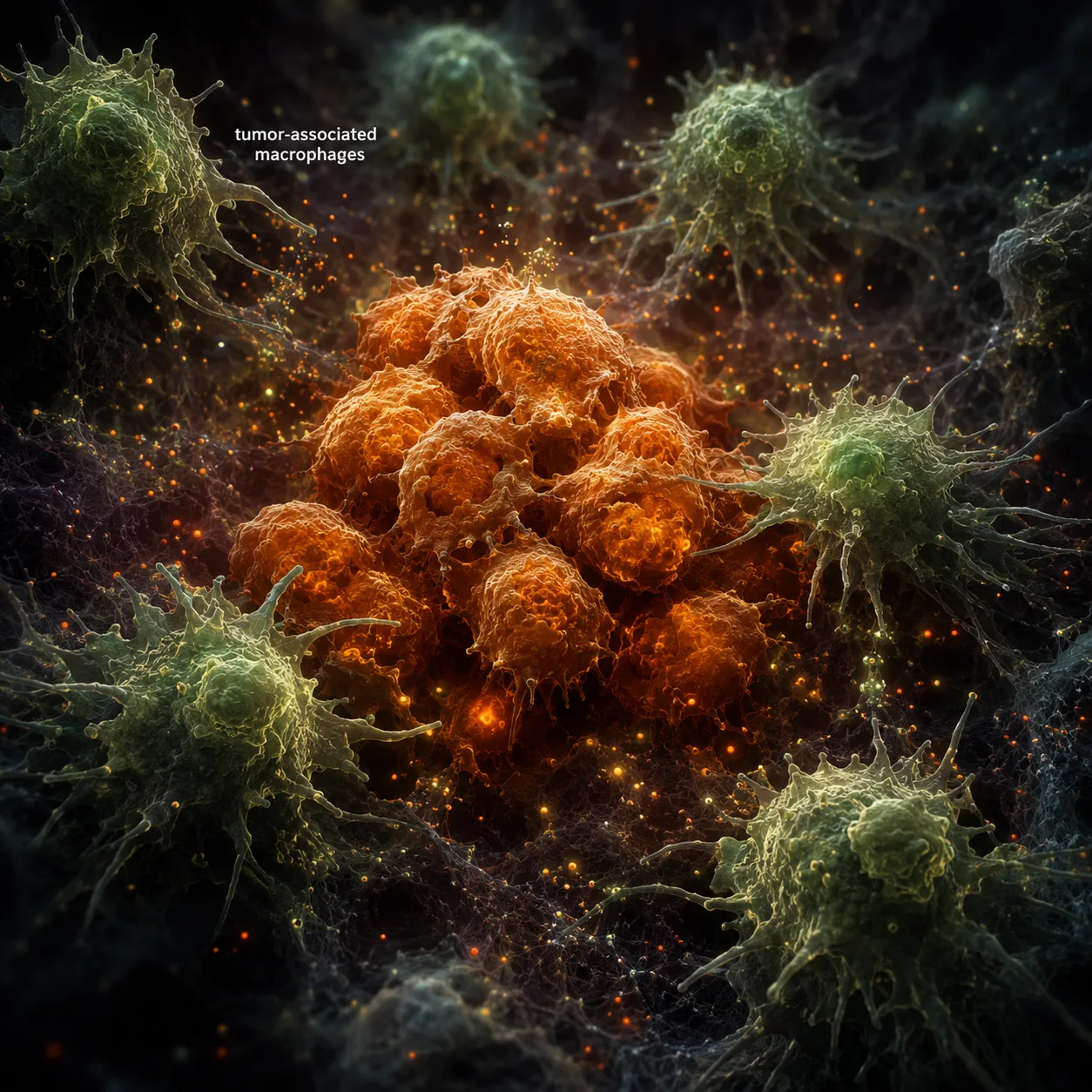
Tumor-associated macrophages
Macrophages are the most abundant immune cell type in many solid tumors, and they exemplify the co-opted inflammation phenotype. Tumor-associated macrophages (TAMs) in established tumors are predominantly anti-inflammatory — they promote tumor growth, support angiogenesis, suppress T cell activity, and facilitate invasion rather than killing cancer cells.
The classical macrophage polarization model distinguishes M1 (pro-inflammatory, tumor-killing) from M2 (anti-inflammatory, tissue-remodeling) phenotypes. Tumors drive macrophage polarization toward M2-like states through:
- IL-4, IL-13 — cytokines from Th2 cells and tumor cells that suppress M1 activation
- M-CSF (CSF-1) — drives macrophage survival and M2-like differentiation
- IL-10, TGF-β — produced by both tumor cells and TAMs, creating a feedback loop
- Hypoxia — the low-oxygen tumor core drives HIF-1α in TAMs, promoting pro-tumorigenic gene expression
Example(What M2-like TAMs actually do for the tumor)
TAMs in an established tumor perform functions that are genuinely useful for the tumor but were originally evolved for wound healing and tissue repair: they secrete VEGF (promoting angiogenesis), MMP9 and other proteases (remodeling ECM to facilitate invasion), EGF (stimulating tumor cell proliferation), TGF-β (suppressing T cell activity), and CCL22 (recruiting Tregs). The tumor has essentially hired macrophages as construction workers and security guards simultaneously.
The signals that do the damage
The inflammatory milieu within tumors is rich in cytokines that were not evolved for tumor promotion but become pro-tumorigenic in this context:
TNF-α was originally named for its tumor-necrosis activity — it can kill cancer cells. But at the chronic low levels typical of the TME, TNF-α activates NF-κB in tumor cells, driving expression of survival genes, proliferative signals, and pro-angiogenic factors. The same cytokine that can acutely kill tumor cells at high doses promotes their survival at chronic low doses.
IL-6 signals through JAK/STAT3 in tumor cells, driving proliferation, anti-apoptotic gene expression (BCL-2, MCL-1), and VEGF production. STAT3 is constitutively activated in many cancers and is one of the key bridges between inflammation and hallmarks #1, #3, and #5.
IL-1β promotes angiogenesis, drives invasion through MMP upregulation, and supports Th17 polarization — a T cell subset associated with pro-tumorigenic rather than anti-tumor immunity in some contexts.
PGE₂ (prostaglandin E2), produced by COX-2 (cyclooxygenase-2), is a lipid mediator that promotes tumor cell survival, angiogenesis, and immune suppression. COX-2 is overexpressed in colorectal, breast, lung, and many other cancers. The epidemiological observation that regular aspirin (a COX inhibitor) reduces colorectal cancer risk is at least partly attributable to PGE₂ suppression.
Intuition(Why aspirin reduces colorectal cancer risk)
Multiple large epidemiological studies and randomized trials have shown that regular aspirin use reduces colorectal cancer incidence and mortality by 20–40%. The mechanism isn't fully resolved but centrally involves COX-2 inhibition: reduced PGE₂ leads to less tumor cell survival signaling, less immune suppression, and less angiogenic drive in colonic epithelium. COX-2 is expressed at high levels in colorectal adenomas and cancers, and PGE₂ promotes WNT/β-catenin signaling — directly relevant to the APC mutations that drive most colorectal cancers.
Cancer-associated fibroblasts
Fibroblasts in the tumor stroma — cancer-associated fibroblasts (CAFs) — are a distinct population from normal tissue fibroblasts, activated by TGF-β and other tumor-derived signals into a pro-tumorigenic state resembling wound-healing myofibroblasts that never resolve.
CAFs contribute to the tumor by:
- Secreting growth factors (HGF, FGF, IGF) that drive tumor cell proliferation and survival
- Remodeling ECM by depositing collagen and activating MMPs, creating a stiff, invasion-permissive matrix
- Secreting CXCL12 (SDF-1), which attracts endothelial progenitors (supporting angiogenesis) and can directly stimulate tumor cells expressing CXCR4
- Physically excluding immune cells from tumor nests through dense collagen deposition — a mechanism of immune exclusion in "cold" tumors
The stiff fibrotic stroma CAFs generate also physically impairs drug delivery and creates mechanical signals (through integrins and YAP/TAZ mechanosensing) that promote tumor cell survival and invasion.
Neutrophils and the SASP
Tumor-associated neutrophils (TANs) follow the same co-option pattern as macrophages — in established tumors they tend to be pro-tumorigenic, secreting MMP9 (which activates VEGF stored in the ECM), suppressing T cell activity, and promoting invasion.
The senescence-associated secretory phenotype (SASP) — mentioned in hallmark #4 — is relevant here. Senescent cells that accumulate in aging tissue and in treated tumors secrete a pro-inflammatory cocktail of cytokines, chemokines, and proteases that recruits immune cells and remodels the microenvironment. Early in carcinogenesis, SASP can reinforce immune surveillance and suppress tumor growth. In established tumors, accumulated senescent stromal cells contribute to the pro-tumorigenic inflammatory milieu instead.
Warning(Senolytic therapy and cancer: a double-edged consideration)
Senolytics — drugs that selectively eliminate senescent cells — are being explored for cancer therapy, both to reduce the pro-tumorigenic SASP and to clear therapy-induced senescent cells that might fuel resistance and relapse. But senescent cells also exert tumor-suppressive functions through paracrine signaling in early lesions, and SASP components can reinforce immune surveillance. Indiscriminate senolytic treatment could, in principle, remove this brake. Context and timing matter — a recurring theme across cancer biology.
The NF-κB connection
Many of the pro-tumorigenic inflammatory signals converge on NF-κB (nuclear factor kappa-light-chain-enhancer of activated B cells) — a transcription factor family that is the master regulator of the inflammatory response. NF-κB drives expression of:
- Survival genes (BCL-2, BCL-XL, survivin)
- Pro-inflammatory cytokines (TNF-α, IL-1β, IL-6)
- Angiogenic factors (VEGF, CXCL8)
- Invasion-promoting enzymes (MMP-2, MMP-9)
- Cell cycle drivers (cyclin D1)
NF-κB is constitutively active in many cancers — activated by oncogene signaling, by inflammatory cytokines in the TME, and by pattern recognition receptor activation from microbial products (relevant to hallmark #13, the microbiome hallmark). It sits at the intersection of inflammation, survival, and proliferation.
Summary(Summary)
Tumor-promoting inflammation is the dark mirror of cancer immunosurveillance. The immune cells that infiltrate tumors — macrophages, neutrophils, fibroblasts — were evolved to resolve tissue damage and fight infection, but in the chronic, non-resolving environment of an established tumor they are co-opted into supporting growth, angiogenesis, invasion, and immune suppression. The key mediators are TAMs (secreting VEGF, MMPs, and immunosuppressive cytokines), CAFs (remodeling stroma and excluding immune cells), and inflammatory cytokines and lipid mediators (TNF-α, IL-6, IL-1β, PGE₂) that signal through NF-κB and STAT3 to drive tumor cell survival and proliferation. The clinical evidence for this is most visible in colorectal cancer — where chronic inflammation drives risk, COX-2/PGE₂ is a central mechanism, and aspirin provides measurable chemoprevention — but the principles apply broadly across solid tumors.