Recall(From hallmark #1)
Hallmark #1 was about the accelerator — cancer cells learn to generate their own go signals. Hallmark #2 is about the brakes. A cell that ignores growth suppressors can divide even when the surrounding tissue is telling it to stop.
Every cell carries its own set of braking systems — proteins that monitor conditions and halt division when something is wrong. Too much DNA damage. Not enough nutrients. No physical space. Normal cells respect these signals. Cancer cells learn to ignore them.
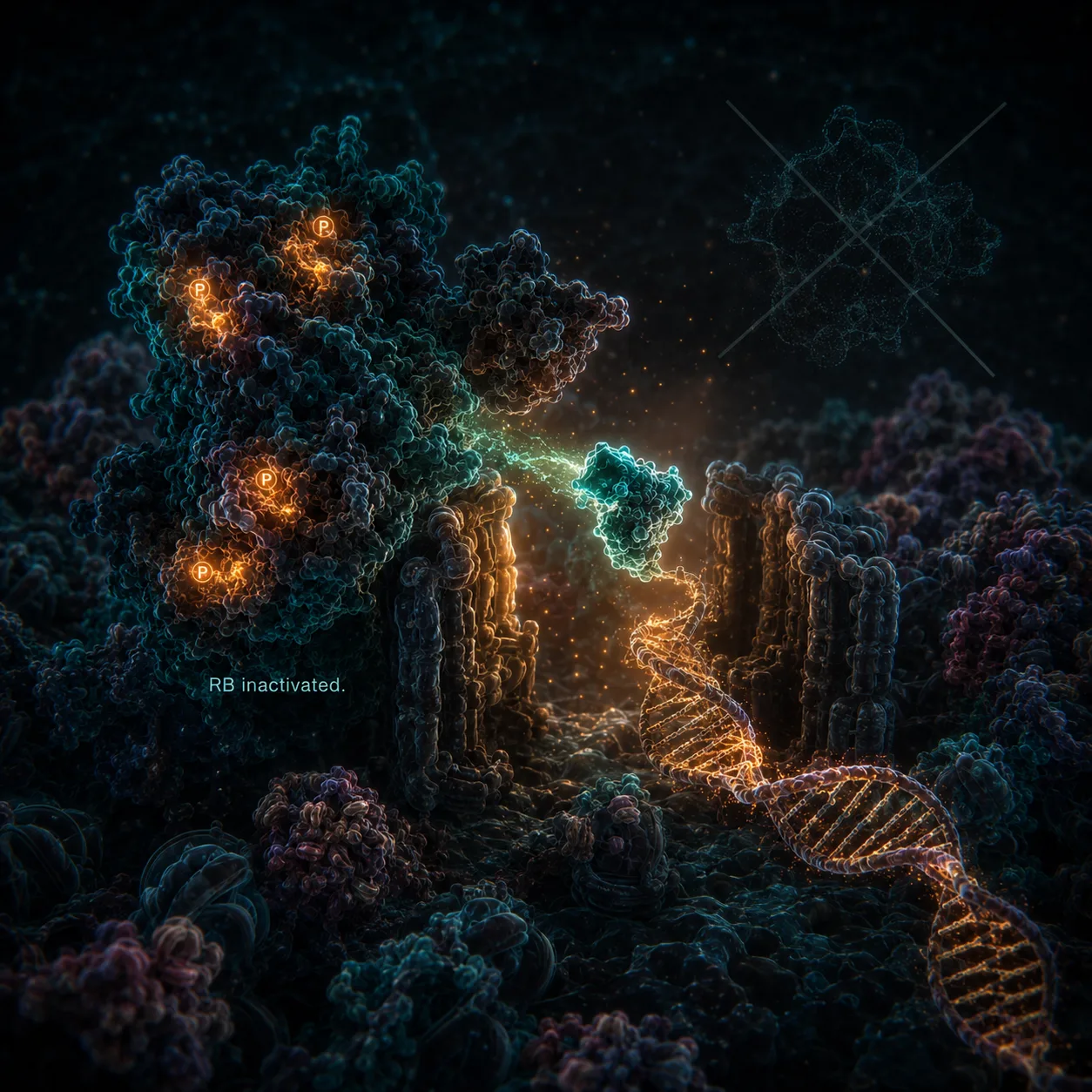
The proteins that enforce these braking signals are called tumor suppressors. Unlike oncogenes (which drive cancer when mutated to be too active), tumor suppressors drive cancer when mutated to be inactive. You need to break them, not activate them.
Definition(Tumor suppressor gene)
A gene whose protein product restricts cell proliferation, promotes apoptosis, or repairs DNA damage. In normal cells, two functional copies are typically sufficient. Cancer generally requires loss of both copies — one inherited or acquired mutation, plus a second "hit" — before the suppressive function is fully lost. First described by Alfred Knudson's two-hit hypothesis (1971).
Why one broken copy isn't enough
Cancer almost never disables a tumor suppressor with a single mutation. Alfred Knudson observed this in retinoblastoma in 1971: children who inherited one mutant copy of the RB gene still needed a second mutation in the remaining copy to develop tumors. One broken copy wasn't enough — the cell had a backup.
This "two-hit" model turns out to apply broadly. Most tumor suppressors require both copies to be inactivated before their protective function is lost. This is also why inherited cancer syndromes (where one hit is present in every cell from birth) dramatically increase cancer risk — you only need one more event instead of two.
RB: the gatekeeper of the cell cycle
The retinoblastoma protein (RB) is arguably the most important tumor suppressor for understanding hallmark #2. It sits directly at the decision point for cell division.
The cell cycle has checkpoints — moments where the cell pauses and assesses whether conditions are right to proceed. The G1 checkpoint, near the start of the cycle, is the critical one: before a cell commits to replicating its DNA, it checks whether growth signals are adequate, whether DNA is intact, and whether there's space to divide.
RB is the enforcer of this checkpoint.
Definition(RB protein (retinoblastoma protein))
A tumor suppressor that acts as a brake on cell cycle entry. In its active (hypophosphorylated) form, RB binds and inactivates E2F transcription factors, preventing transcription of genes needed for S-phase entry. When conditions are right, cyclin-CDK complexes phosphorylate RB, releasing E2F and allowing the cycle to proceed.
When RB is active — bound to E2F transcription factors — the cell can't enter S phase. It's stuck. To release this brake, mitogenic signals activate cyclin D and CDK4/6, which phosphorylate RB and release E2F. The genes needed for DNA replication switch on.
Cancer disrupts this system at multiple points:
- Direct RB mutation — loss of both copies (as in retinoblastoma, small cell lung cancer, osteosarcoma)
- CDK4/6 amplification — constitutively phosphorylating RB even without mitogenic input
- Cyclin D overexpression — same effect as CDK4/6 amplification
- Loss of p16/CDKN2A — p16 is a CDK inhibitor that normally prevents RB phosphorylation; loss of p16 is one of the most common alterations in human cancer
Note
CDK4/6 inhibitors (palbociclib, ribociclib, abemaciclib) work by restoring RB's braking function — they block the kinases that would otherwise phosphorylate and inactivate RB. They've become standard of care in HR+/HER2− breast cancer, where cyclin D overexpression or p16 loss are common. The therapy essentially re-engages the brake that the tumor disabled.
p53: guardian of the genome
If RB is the gatekeeper, p53 is the emergency system. Where RB enforces routine checkpoints, p53 activates in response to stress — DNA damage, hypoxia, oncogene activation, nucleotide depletion — and decides what happens next.
p53 is a transcription factor. When activated, it can drive expression of genes that:
- Pause the cell cycle (p21, which inhibits CDKs)
- Repair DNA (various repair pathway genes)
- Trigger apoptosis (BAX, PUMA, NOXA) if damage is irreparable
Definition(p53 (TP53))
A tumor suppressor transcription factor encoded by TP53, sometimes called the "guardian of the genome." Activated by cellular stress signals, p53 coordinates cell cycle arrest, DNA repair, and apoptosis. Mutated or lost in approximately 50% of all human cancers — more than any other single gene. p53 loss is particularly prevalent in high-grade serous ovarian cancer (~96%), small cell lung cancer (~90%), and triple-negative breast cancer (~80%).
The logic of p53 is: if you can't be fixed, you shouldn't replicate. A cell with extensive DNA damage that replicates anyway is a cancer cell in the making. p53 tries to prevent this.
Example(How p53 responds to DNA damage)
When ionizing radiation damages DNA, double-strand breaks activate the ATM kinase, which phosphorylates and stabilizes p53 (normally p53 is rapidly degraded by MDM2). Stabilized p53 accumulates and activates p21, which inhibits CDK2 and arrests the cell at G1. The cell waits for repair. If repair succeeds, p53 levels fall and the cycle resumes. If damage is too extensive, p53 drives expression of pro-apoptotic genes instead.
Loss of p53 doesn't make a cell divide faster — it removes the surveillance system that would catch a damaged cell before it divided. A p53-null cell can replicate through DNA damage that would normally trigger arrest or death, accumulating further mutations with each division.
Beyond RB and p53
RB and p53 are the canonical examples but not the whole story. Other tumor suppressors operate across multiple layers:
| Suppressor | Function | Cancer context |
|---|---|---|
| PTEN | Phosphatase opposing PI3K/AKT signaling | Lost in ~30% of all cancers; especially endometrial, prostate, glioblastoma |
| APC | Regulates Wnt/β-catenin pathway | Mutated in ~80% of colorectal cancers |
| BRCA1/2 | DNA repair (homologous recombination) | Hereditary breast and ovarian cancer |
| VHL | Regulates HIF-1α (hypoxia response) | Clear cell renal cell carcinoma |
| NF1/NF2 | RAS-GAP activity; cytoskeletal regulation | Neurofibromatosis; schwannomas, meningiomas |
| SMAD2/4 | TGF-β pathway effectors | Pancreatic, colorectal cancers |
Intuition(Why TGF-β deserves its own mention)
TGF-β (transforming growth factor beta) is a cytokine that normally suppresses epithelial cell proliferation — it's a growth inhibitor in many cell types. In early cancer, cells evade its anti-proliferative signal by mutating its receptors (TGFBR1, TGFBR2) or its downstream effectors (SMAD2, SMAD4). In a dark irony, later-stage cancers often co-opt TGF-β and begin secreting it themselves — at that point it promotes invasion and immune suppression instead of inhibiting growth. The same pathway switches from brake to accelerant as the tumor evolves.
Contact inhibition
There's one more suppressive mechanism worth understanding — one that doesn't map neatly to a single gene: contact inhibition.
Normal epithelial cells stop dividing when they make contact with neighboring cells. A confluent layer of cells is growth-arrested — the cells sense physical crowding and switch off proliferation. This is mediated partly by the Hippo pathway (through YAP/TAZ transcription factors) and partly by E-cadherin signaling at cell junctions.
Cancer cells lose contact inhibition. They pile up on each other, growing in three dimensions instead of forming a well-organized single layer. Loss of E-cadherin — which happens early in many epithelial cancers and is required for epithelial-mesenchymal transition — disrupts the junction-based signaling that enforces this behavior.
Summary(Summary)
Hallmark #2 is the mirror image of hallmark #1. Where #1 is about generating growth signals autonomously, #2 is about ignoring the signals that say stop. The primary mechanisms are inactivation of RB (removing the G1 checkpoint gatekeeper), loss of p53 (disabling the stress-response surveillance system), and disruption of other suppressors across multiple pathways (PTEN, APC, SMAD4, TGF-β receptors). Cancer rarely disables just one suppressor — it tends to accumulate multiple lesions across these parallel braking systems, making the eventual phenotype robust to any single therapeutic intervention targeting one pathway.