Recall(Added in 2011)
The original 2000 hallmarks focused on growth, survival, and spread. The 2011 update added two hallmarks reflecting how deeply cancer rewires normal cellular physiology. Hallmark #7 — metabolic reprogramming — had been observed for nearly a century before anyone understood why it existed.
In 1924, Otto Warburg made an observation that puzzled biologists for decades: cancer cells consume glucose and produce lactate even in the presence of oxygen. This was strange. Normal cells use oxygen to fully oxidize glucose through the TCA cycle and oxidative phosphorylation, generating roughly 36 ATP per glucose molecule. Cancer cells seemed to prefer glycolysis — which produces only 2 ATP per glucose — even when oxygen was available.
This became known as the Warburg effect, or aerobic glycolysis. Warburg himself thought it reflected damaged mitochondria. He was wrong about the mechanism, but right that it was fundamental.
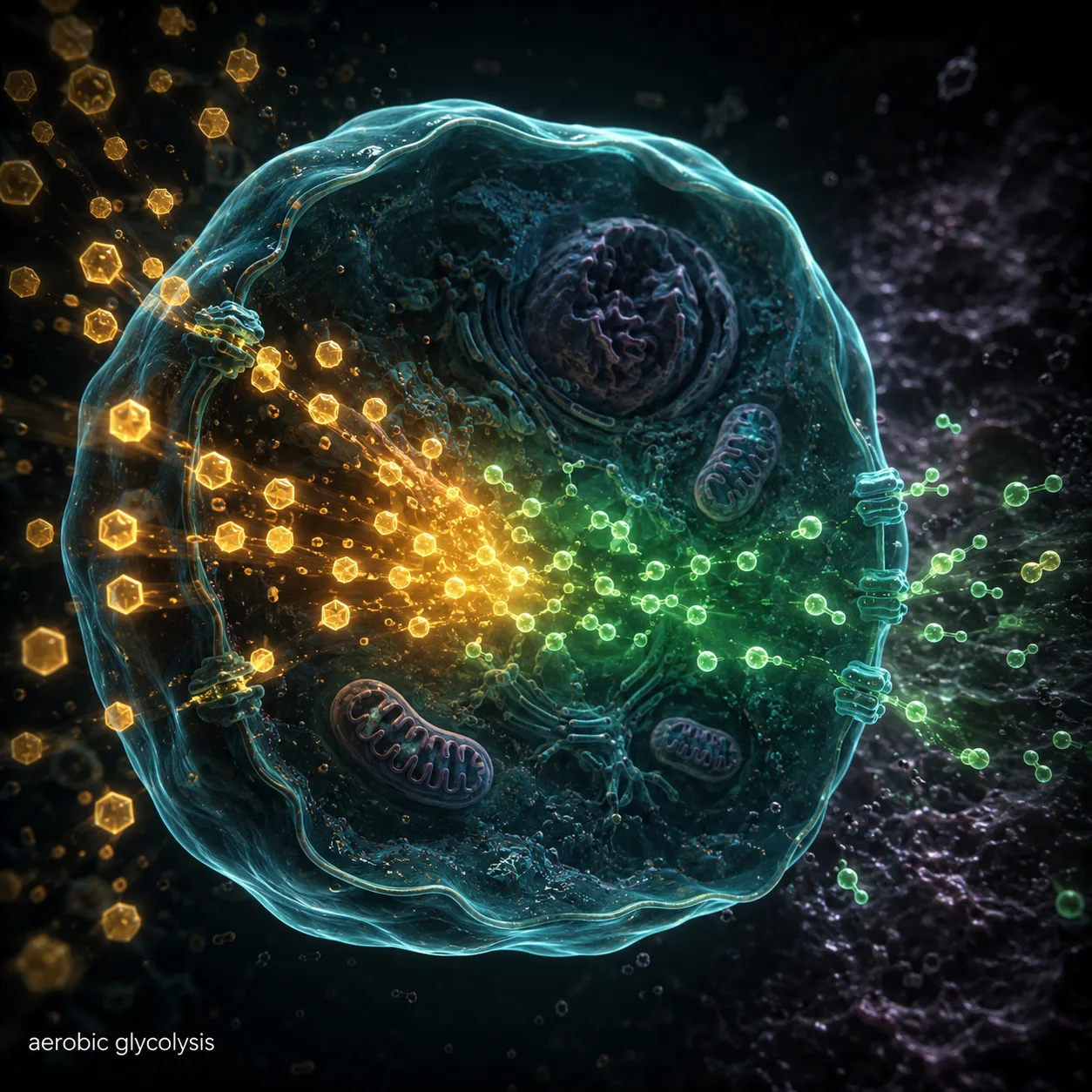
Why aerobic glycolysis makes sense for a tumor
The efficiency argument misses the point. ATP yield per glucose molecule is not what a growing tumor is optimizing for. It is optimizing for biomass — the raw materials needed to build new cells.
A dividing cell needs not just energy but nucleotides (for DNA), amino acids (for proteins), and lipids (for membranes). Glycolytic intermediates feed directly into the biosynthetic pathways that produce all of these. The pentose phosphate pathway (branching off glycolysis at glucose-6-phosphate) generates ribose-5-phosphate for nucleotide synthesis and NADPH for lipid synthesis and antioxidant defense. Pyruvate feeds into amino acid synthesis. Citrate, diverted from the TCA cycle, is exported to the cytoplasm for fatty acid synthesis.
Intuition(Glucose as a building material, not just a fuel)
The counterintuitive insight is that for a rapidly proliferating cell, carbon is more limiting than ATP. A tumor cell needs to double its entire mass — membranes, DNA, proteins — before each division. Routing glucose into biosynthetic pathways rather than full oxidation sacrifices ATP efficiency but provides the carbon skeletons that growth requires. Full oxidative phosphorylation burns the carbon all the way to CO₂ — useful for energy, but the carbon is gone.
The Warburg effect also has an additional advantage: it acidifies the tumor microenvironment. The exported lactate and protons lower extracellular pH, which is toxic to normal cells and immune infiltrates but tolerated by cancer cells that have adapted to it — creating a chemical barrier around the tumor.
How oncogenes rewire metabolism
Metabolic reprogramming is not an independent hallmark so much as a downstream consequence of the signaling alterations in hallmarks #1 and #2. Oncogenes and tumor suppressors directly regulate metabolic enzymes.
MYC is the most direct metabolic oncogene. MYC transcriptionally activates virtually every gene in the glycolytic pathway, drives glutamine uptake and utilization (glutaminolysis — a parallel carbon source to glucose), and suppresses mitochondrial biogenesis in some contexts.
RAS activation (via PI3K/AKT/mTOR) upregulates glucose transporter expression (GLUT1, GLUT3) and hexokinase activity, increasing glucose uptake and committing it to glycolysis. mTOR additionally activates HIF-1α even under normoxic conditions, which transcriptionally drives the glycolytic enzyme program.
p53 loss removes a regulator of metabolic balance. Wild-type p53 promotes oxidative phosphorylation (through TIGAR and SCO2) and suppresses glycolysis. Loss of p53 shifts the balance toward the Warburg phenotype.
Definition(Glutaminolysis)
The catabolism of glutamine — the most abundant amino acid in plasma — to support biosynthesis and energy production. Cancer cells frequently become highly glutamine-dependent, using it as a nitrogen source for nucleotide and amino acid synthesis and as a carbon source feeding into the TCA cycle. MYC is the primary driver of glutaminolysis in cancer. Glutamine deprivation kills many cancer cell lines that are glucose-sufficient, illustrating that metabolic reprogramming involves multiple nutrients, not just glucose.
Beyond glycolysis
IDH mutations and the oncometabolite
Not all metabolic reprogramming is about glycolysis. A distinct class of metabolic alterations involves mutations in TCA cycle enzymes — most notably IDH1 and IDH2 (isocitrate dehydrogenase).
Normal IDH1/2 convert isocitrate to α-ketoglutarate (αKG) in the TCA cycle. Oncogenic IDH mutations (IDH1 R132H is the most common) give the enzyme a new, aberrant activity: converting αKG to 2-hydroxyglutarate (2-HG), an oncometabolite.
Definition(Oncometabolite)
A metabolite produced at abnormally high levels by cancer-associated enzyme mutations that drives tumor development through mechanisms beyond energy metabolism — typically by competitively inhibiting αKG-dependent dioxygenases, including histone and DNA demethylases. 2-hydroxyglutarate (from IDH mutations), succinate (from SDH mutations), and fumarate (from FH mutations) are the three recognized oncometabolites.
2-HG competitively inhibits a family of enzymes that use αKG as a cofactor — including TET DNA demethylases and histone demethylases. The result is global hypermethylation of DNA and histones, locking cells in a dedifferentiated state. IDH-mutant gliomas and AML show a characteristic CpG island methylator phenotype (CIMP) that traces directly to 2-HG accumulation.
This connects metabolism directly to epigenetics — and to hallmark #12 (nonmutational epigenetic reprogramming), which the 2022 update would formalize.
Example(IDH inhibitors in AML and glioma)
Ivosidenib (IDH1 inhibitor) and enasidenib (IDH2 inhibitor) are approved for IDH-mutant AML, and ivosidenib for IDH1-mutant cholangiocarcinoma. Vorasidenib, a brain-penetrant dual IDH1/2 inhibitor, was approved in 2024 for IDH-mutant low-grade glioma — one of the first approvals for a diffuse glioma subtype in decades. These drugs work by blocking 2-HG production and allowing differentiation programs to re-engage.
Lipids and one-carbon metabolism
Two other metabolic programs deserve mention:
Lipid synthesis is dramatically upregulated in many cancers. Proliferating cells need membranes; membranes are made of phospholipids; phospholipids require fatty acids. Fatty acid synthase (FASN) is overexpressed in prostate, breast, and ovarian cancers, among others. Citrate diverted from the TCA cycle provides the acetyl-CoA building blocks.
One-carbon metabolism — centered on folate and methionine cycling — supplies the methyl groups needed for DNA methylation, histone methylation, and nucleotide synthesis. This pathway is the target of classical chemotherapy agents (methotrexate, 5-fluorouracil) that were known to work long before the molecular basis of metabolic reprogramming was understood.
Targeting cancer metabolism
The metabolic differences between cancer and normal cells are real — but so is the challenge of exploiting them therapeutically. Normal proliferating cells (gut epithelium, bone marrow) share many of the same metabolic demands as tumor cells.
| Target | Drug | Status |
|---|---|---|
| IDH1 | Ivosidenib | Approved (AML, cholangiocarcinoma) |
| IDH1/2 | Vorasidenib | Approved (low-grade glioma, 2024) |
| IDH2 | Enasidenib | Approved (AML) |
| Glutaminase (GLS) | CB-839 (telaglenastat) | Phase II/III (multiple tumors) |
| LDHA / glycolysis | Multiple agents | Preclinical / early clinical |
| FASN | TVB-2640 | Phase II (breast, lung) |
The IDH inhibitors are the clearest success story — the oncometabolite is tumor-specific by definition, making the selectivity problem tractable. Broader metabolic targets (LDHA, glutaminase) face the challenge that normal proliferating tissues also depend on them.
Summary(Summary)
Cancer cells reprogram their metabolism to favor aerobic glycolysis (the Warburg effect) not because it's more efficient at producing ATP, but because it funnels glucose carbon into biosynthetic pathways needed for rapid cell growth. This reprogramming is driven by oncogenes (MYC, RAS/PI3K/mTOR) and tumor suppressor loss (p53) that directly regulate metabolic enzymes. Beyond glycolysis, IDH1/2 mutations produce the oncometabolite 2-HG, which drives epigenetic hypermethylation and blocks differentiation — a mechanism that directly bridges hallmarks #7 and #12. IDH inhibitors represent the clearest therapeutic success in targeting cancer metabolism, while broader metabolic targets face selectivity challenges because normal proliferating tissues share many of the same demands.