Recall(From the intro post)
The Hallmarks framework asks: what capabilities does a normal cell have to acquire before it becomes cancer? Sustaining proliferative signaling is the first and most fundamental of those capabilities — the entry point for almost everything else.
Normal cells are social. They don't divide unless they receive permission — a chemical signal from their environment that says now is a good time to grow. Cancer's first move is to stop waiting for permission.
How normal proliferation works
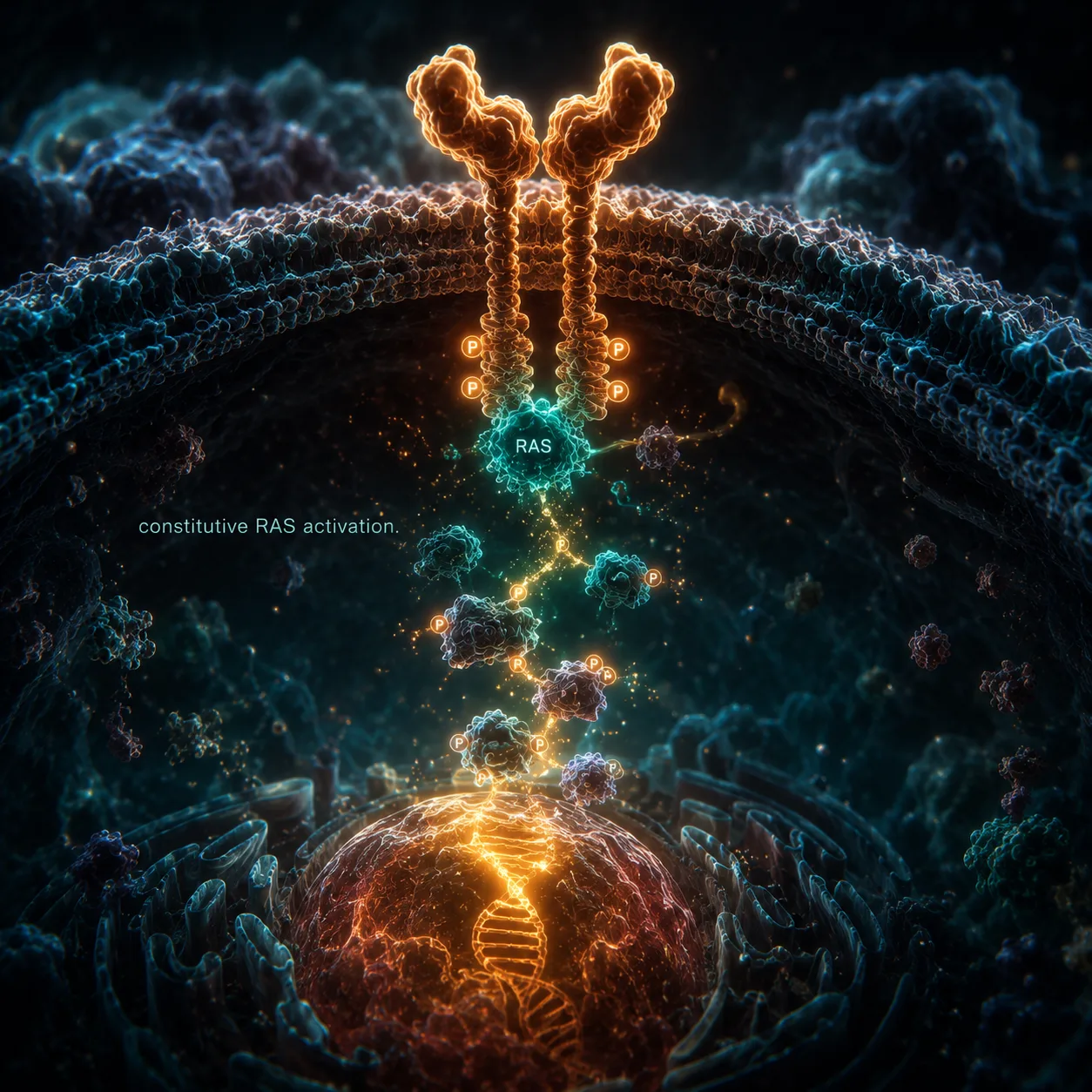
Every cell in your body has surface receptors that listen for growth signals. When a growth factor — a small protein released by nearby cells — binds to one of these receptors, it triggers a chain reaction inside the cell: a signaling cascade that eventually reaches the nucleus and flips on the genes that drive cell division.
Definition(Growth factor)
A secreted protein that binds to receptors on a target cell's surface and triggers intracellular signaling cascades that promote cell survival, growth, or division. Examples include EGF (epidermal growth factor), PDGF (platelet-derived growth factor), and FGF (fibroblast growth factor).
The key thing about this system is that it's tightly regulated. Growth factors are released in specific contexts — wound healing, tissue renewal, embryonic development — and the signals they trigger are temporary. They switch on, drive a round of division, and switch off. The cell waits for the next signal.
Cancer breaks this loop entirely.
Four ways cancer hijacks the signal
1. Autocrine signaling — making your own growth factors
Some cancer cells start producing the same growth factors they're supposed to be receiving. They secrete the signal and then respond to it themselves, creating a self-sustaining loop that doesn't require any input from the surrounding tissue.
This was one of the first mechanisms identified. Sarcomas were found to produce PDGF (platelet-derived growth factor) — a growth factor normally released by platelets to stimulate healing — and to express the receptor for it. The tumor was both sending and receiving its own go signal.
Example(Autocrine signaling in glioblastoma)
Glioblastoma cells frequently overexpress both EGF (epidermal growth factor) and its receptor EGFR. The cells stimulate themselves continuously, independent of whether neighboring tissue thinks growth is warranted.
2. Receptor overexpression — turning up the sensitivity
Even without producing extra growth factors, a cell can amplify its response to normal environmental signals by putting far more receptors on its surface than usual. With 10× or 100× the normal receptor density, a cell becomes exquisitely sensitive to even trace amounts of growth factor — amounts that wouldn't trigger division in a normal cell.
HER2 (also called ERBB2) is the textbook example. In about 20% of breast cancers, the gene encoding HER2 is amplified — sometimes 25–50 copies instead of the normal 2. The cells are covered in HER2 receptors and respond to minimal stimulation with maximal growth drive.
Note
HER2 overexpression is clinically significant because it's targetable. Trastuzumab (Herceptin) is a monoclonal antibody that binds HER2 and blocks its signaling — one of the earliest examples of a therapy designed directly around a hallmark mechanism.
3. Constitutively active receptors — stuck in the "on" position
A third strategy bypasses the growth factor entirely. Mutations in the receptor itself can lock it into its active conformation — it behaves as if a growth factor is permanently bound, even when none is present.
EGFR mutations in non-small-cell lung cancer are a well-characterized version of this. Specific point mutations (particularly in exons 19 and 21) cause the receptor to fire continuously without ever receiving an external signal. Gefitinib and erlotinib — EGFR inhibitors — were developed specifically to block this constitutively active receptor.
4. Mutations downstream — bypassing the receptor entirely
The most common mechanism doesn't involve the receptor at all. Instead, cancer mutates the signaling molecules that sit inside the cell, downstream of the receptor in the cascade.
RAS proteins sit at a critical junction in nearly every growth signaling pathway. When a receptor is activated, it triggers RAS to switch from its inactive form (bound to GDP) to its active form (bound to GTP). Normally, RAS has a built-in timer — it hydrolyzes GTP back to GDP and switches itself off.
Mutations in RAS disable this timer. The protein is locked in the active, GTP-bound state permanently.
Definition(RAS oncogene)
A family of small GTPase proteins (KRAS, NRAS, HRAS) that relay growth signals from receptors to intracellular effector pathways. Mutations in KRAS are found in approximately 30% of all human cancers, making it the most commonly mutated oncogene family. KRAS mutations are especially prevalent in pancreatic cancer (~90%), colorectal cancer (~40%), and lung adenocarcinoma (~30%).
Example(Why KRAS is so hard to drug)
For decades, KRAS was considered "undruggable" — its surface has few obvious binding pockets for small molecules, and its affinity for GTP is extremely high, making competitive inhibition impractical. The first KRAS-specific inhibitor (sotorasib, targeting the KRAS G12C mutation) wasn't approved until 2021, more than 40 years after the gene was discovered.
The feedback problem
Normal signaling pathways are self-limiting. After a receptor fires, the cell activates negative feedback mechanisms that dampen the signal — receptor internalization and degradation, phosphatases that inactivate signaling intermediates, inhibitory proteins that compete with activating ones.
Cancer doesn't just activate growth signaling — it systematically disables these feedback mechanisms. PTEN, for instance, is a phosphatase that opposes the PI3K/AKT pathway (a major downstream growth pathway). Loss-of-function mutations in PTEN are found in a wide range of cancers; without PTEN, the AKT signal runs unchecked even when upstream inputs are modest.
Warning(Why targeted therapies often stop working)
When a therapy targets one node in the signaling network — say, an EGFR inhibitor — the tumor can acquire resistance by mutating a downstream node to be constitutively active. The upstream signal is blocked, but the pathway fires anyway. This is why resistance to targeted therapies almost always involves downstream or parallel pathway mutations rather than simply re-acquiring the original mutation.
What this looks like in the clinic
The practical consequence of this hallmark is that cancer cells divide in the absence of any environmental justification. Normal cells divide when tissue needs repair or renewal; cancer cells divide because their internal signaling apparatus is stuck on go.
This creates a therapeutic opening — if cancer cells depend on specific mutated signaling proteins that normal cells don't rely on in the same way, those proteins become targets. The success of imatinib in CML (targeting BCR-ABL, a constitutively active kinase fusion), trastuzumab in HER2+ breast cancer, and the EGFR inhibitors in lung cancer all follow this logic directly.
The harder problem is that the same pathways are used for legitimate purposes in normal tissue. Blocking RAS signaling in a tumor also blocks it in cells that genuinely need it. This is the root of the selectivity problem in oncology — not "can we target this pathway" but "can we target it specifically enough to matter."
Summary(Summary)
Cancer cells sustain their own proliferative signaling through four main mechanisms: autocrine production of growth factors, receptor overexpression, constitutively activating receptor mutations, and downstream pathway mutations (especially RAS). The net effect is that the cell no longer needs external permission to divide. Targeted therapies attempt to exploit the tumor's specific dependence on mutated signaling nodes, but resistance frequently emerges through downstream pathway activation — a direct consequence of how interconnected these networks are.